What Is a Compass Rose? How It Works and Why It’s Important Meaning, History, Types and Uses Explained

Every great journey begins with knowing which way to go. Long before smartphones, GPS devices, and digital maps guided travelers to their destinations, sailors crossed vast oceans, explorers charted unknown lands, and merchants traveled across continents using one simple yet powerful symbol—the compass rose. Though it may seem like a decorative feature printed on maps, the compass rose has played an essential role in navigation for centuries. It has helped people understand direction, interpret maps, and travel with confidence, making it one of the most recognizable symbols in geography and cartography.
Today, the compass rose remains just as relevant as ever. It appears on printed maps, educational materials, hiking guides, marine charts, and even digital mapping applications. Beyond its practical purpose, it has also become a symbol of guidance, adventure, exploration, and finding one’s path in life. Whether you are a student learning geography, a traveler planning a route, or someone simply curious about map symbols, understanding the compass rose provides valuable insight into how humans have navigated the world throughout history.
Also Read: Toes: Anatomy, Functions, Common Conditions, and How to Keep Them Healthy
What Is a Compass Rose?
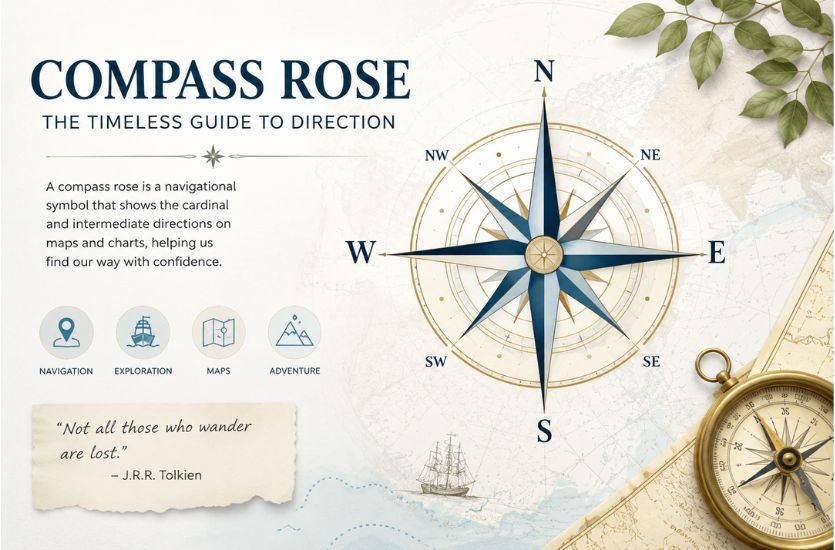
A compass rose is a diagram or symbol found on maps, charts, and navigation tools that displays the principal directions used for orientation. At its simplest, it shows the four cardinal directions: north, south, east, and west. More detailed versions also include intermediate directions such as northeast, northwest, southeast, and southwest, while advanced designs may display up to 32 directional points.
The primary purpose of a compass rose is to help users determine direction when reading a map. By showing where north is located, it allows readers to understand the orientation of roads, landmarks, cities, mountains, rivers, and other geographic features.
Although many modern navigation systems automatically orient maps, the compass rose remains an essential element because it provides a quick visual reference that improves understanding and accuracy.
Why Is It Called a Compass Rose?
The name “compass rose” comes from the artistic appearance of early directional diagrams. Medieval mapmakers often created elaborate compass designs with decorative points extending outward like flower petals. The finished design resembled a blooming rose, leading to the term “compass rose.”
In many historical maps, these decorative symbols were beautifully illustrated using colorful artwork, intricate patterns, and elegant lettering. Rather than serving only as practical navigation tools, they also reflected the artistic craftsmanship of cartographers during the Age of Exploration.
Because of this unique appearance, the term has remained in use for centuries, even though many modern compass roses feature simpler, cleaner designs.
The History of the Compass Rose
The history of the compass rose is closely connected with the development of navigation itself. Before magnetic compasses were invented, travelers relied on natural observations such as the position of the sun, stars, moon, coastlines, and prevailing winds to determine direction.
Ancient civilizations including the Egyptians, Greeks, Romans, and Phoenicians developed remarkable navigation skills without modern instruments. Sailors memorized coastlines, observed celestial bodies, and learned seasonal wind patterns to travel safely across seas.
The invention of the magnetic compass in ancient China transformed navigation forever. Historians believe magnetic compasses were first developed more than two thousand years ago and gradually spread throughout Asia, the Middle East, and Europe. As navigation became more reliable, mapmakers began adding directional diagrams to charts so sailors could interpret routes more easily.
By the 13th and 14th centuries, compass roses became standard features on portolan charts—highly detailed nautical maps used by Mediterranean sailors. These charts often displayed multiple compass roses connected by lines representing navigational bearings.
During the Age of Exploration, explorers such as Christopher Columbus, Vasco da Gama, and Ferdinand Magellan relied heavily on maps featuring compass roses while sailing across unknown oceans. Their voyages expanded geographical knowledge and helped establish global trade routes.
Today, despite remarkable advances in satellite navigation, the compass rose continues to appear on printed and digital maps because it remains an effective and universally understood directional symbol.
The Main Parts of a Compass Rose
Although compass roses vary in complexity, they all share the same basic purpose: showing direction.
The most familiar part is the set of four cardinal directions. North usually appears at the top of the diagram, south at the bottom, east on the right, and west on the left. These four directions form the foundation of navigation and geography.
Many compass roses also include four intercardinal directions positioned between the cardinal points. These are northeast, northwest, southeast, and southwest. Including these additional directions provides greater accuracy when describing locations and planning routes.
More advanced compass roses include secondary directions such as north-northeast, east-northeast, south-southwest, and west-northwest. These additional points increase navigational precision, especially for marine and aviation purposes.
Some modern compass roses also display degree measurements. North represents either 0 or 360 degrees, east equals 90 degrees, south equals 180 degrees, and west equals 270 degrees. These measurements allow navigators to calculate exact bearings instead of relying solely on named directions.
Different Types of Compass Roses
Compass roses have evolved over time to meet different navigational needs.
The simplest version is the four-point compass rose. It displays only north, south, east, and west. This type is commonly found in elementary school textbooks, simple maps, and educational worksheets because it is easy for beginners to understand.
The eight-point compass rose expands upon this by adding northeast, southeast, southwest, and northwest. It is widely used on road maps, hiking maps, and classroom materials because it provides more accurate directional information without becoming overly complex.
The sixteen-point compass rose introduces additional intermediate directions, allowing users to describe locations with much greater precision. This version has historically been popular among sailors and experienced navigators.
The thirty-two-point compass rose represents one of the most detailed traditional systems. Each directional point is separated by 11.25 degrees, enabling extremely accurate navigation. This design became especially important during the era of sailing ships when precise course adjustments could determine the success of long ocean voyages.
How a Compass Rose Works
The compass rose itself does not determine direction. Instead, it provides a visual reference that helps users interpret a map or chart.
When using a map, the first step is identifying where north is located using the compass rose. Once north is known, every other direction becomes clear. A location positioned to the right of north lies toward the east, while locations below north are generally south.
Suppose a map shows a mountain located northeast of a town. By consulting the compass rose, the reader immediately understands that traveling diagonally between north and east will lead toward the mountain.
This simple reference system allows people to describe locations consistently regardless of where they are in the world.
Why the Compass Rose Is Important
The importance of the compass rose extends far beyond simple map reading. It provides a universal language for describing direction that is understood across cultures and countries.
Without a compass rose, interpreting maps would become much more difficult because readers would have no reliable way to determine orientation. Roads, rivers, buildings, and landmarks would lose much of their geographic context.
Students use compass roses to develop spatial awareness and geographic skills. Hikers depend on them when navigating trails. Sailors rely on them for marine charts, while pilots use similar directional references in aviation navigation.
Even people using smartphone navigation benefit indirectly from compass rose principles because digital maps are still based on directional orientation.
Compass Rose in Navigation
Navigation has always depended on accurate direction. The compass rose provides an essential framework that allows navigators to communicate routes clearly.
In marine navigation, compass roses appear on nautical charts showing safe sailing routes, underwater hazards, ports, and coastal features. Captains combine these charts with magnetic compasses and modern electronic systems to guide vessels safely across oceans.
Aviation charts also rely on directional references similar to compass roses. Pilots calculate headings, bearings, and flight paths using degrees and compass directions to ensure safe travel between airports.
Land navigation uses compass roses on hiking maps, military maps, and topographic charts. Outdoor enthusiasts often combine paper maps with handheld compasses to navigate remote areas where GPS signals may be unavailable.
Compass Rose in Education
One of the first geography concepts children learn is the compass rose. Teachers use simple directional diagrams to introduce students to north, south, east, and west before progressing to more advanced geographic concepts.
Learning to interpret a compass rose helps students understand maps, identify relative locations, describe routes, and develop critical thinking skills. Classroom activities often involve locating cities, rivers, parks, or landmarks based on compass directions.
These foundational skills become valuable throughout life because map reading remains important for travel, geography, environmental studies, and emergency preparedness.
Compass Rose vs. a Compass
Although the names are similar, a compass rose and a compass serve different purposes.
A compass is a physical instrument containing a magnetized needle that aligns with Earth’s magnetic field. It actively indicates which direction is north and can be used almost anywhere.
A compass rose, on the other hand, is simply a printed or digital diagram showing directional relationships. It cannot determine north by itself but instead helps users interpret orientation once north has been established.
The two work together perfectly. A compass identifies direction, while the compass rose helps explain and visualize it on a map.
Compass Rose vs. Wind Rose
The compass rose is sometimes confused with the wind rose because both feature circular designs with radiating lines.
A compass rose focuses on navigation and directional orientation. It tells users where north, south, east, and west are located.
A wind rose is a meteorological diagram that displays the frequency and direction of winds at a specific location over time. Meteorologists, engineers, architects, and environmental scientists use wind roses to analyze climate patterns rather than navigate.
Although the designs may look similar, their purposes are entirely different.
Symbolism of the Compass Rose
Beyond geography, the compass rose has developed powerful symbolic meanings. It often represents guidance, hope, purpose, adventure, exploration, and the courage to move forward.
Many travelers view it as a reminder to embrace new experiences. Writers use it to symbolize life’s journey, while businesses incorporate compass rose designs into logos representing leadership, vision, and direction.
The symbol is also popular in jewelry, tattoos, home décor, and artwork because it conveys the idea of staying true to one’s path regardless of life’s challenges.
Compass Rose in the Digital Age
Modern technology has transformed navigation, yet the compass rose remains surprisingly relevant.
Digital mapping platforms continue to include compass icons that help users reorient maps. GPS navigation systems calculate routes using the same directional principles established centuries ago. Geographic Information Systems (GIS), drone mapping software, and satellite imagery all rely on consistent directional orientation.
Even though people rarely unfold large paper maps today, the concept behind the compass rose continues to support nearly every modern navigation technology.
Common Mistakes When Using a Compass Rose
Many beginners assume that every map automatically places north at the top. While this is true for most maps, some specialized maps use different orientations. Checking the compass rose prevents confusion and ensures accurate interpretation.
Another common mistake is confusing east and west, particularly when maps are rotated. Carefully locating north first makes identifying the remaining directions much easier.
Some people also overlook intermediate directions, limiting their ability to describe locations accurately. Learning all eight principal directions greatly improves navigation skills.
The Lasting Legacy of the Compass Rose
Few symbols have influenced human exploration as profoundly as the compass rose. It has guided sailors across uncharted seas, supported explorers discovering new continents, helped students understand geography, and continues to assist millions of people using maps every day.
Its enduring value lies in its remarkable simplicity. With just a few carefully arranged points, the compass rose transforms a collection of lines and symbols into an understandable representation of the world. It bridges the gap between maps and reality, allowing people to navigate confidently whether crossing oceans, hiking mountain trails, driving unfamiliar roads, or exploring cities.
Even in an era dominated by satellites, artificial intelligence, and digital navigation, the compass rose remains a timeless symbol of direction, discovery, and human curiosity. It reminds us that every destination begins with understanding where we are, where we want to go, and which direction will lead us there. For centuries it has pointed explorers toward the unknown, and its elegant design continues to inspire both practical navigation and the universal pursuit of new horizons.