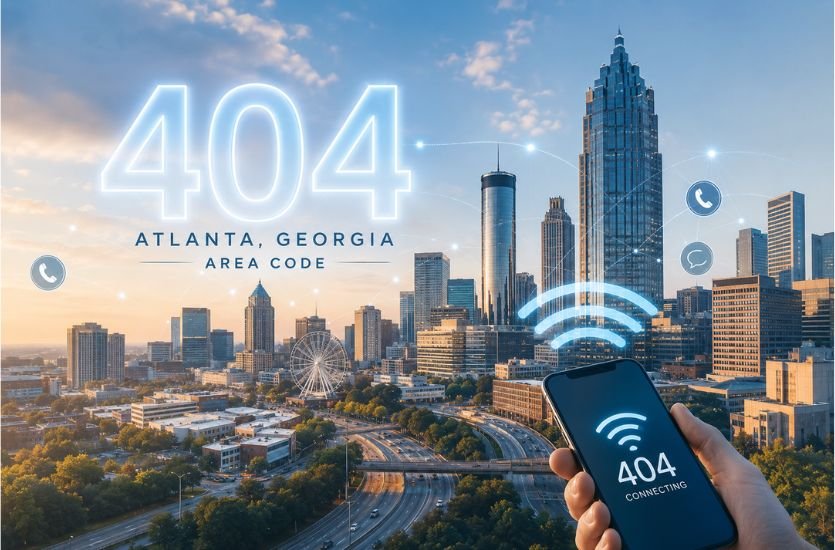

A single three-digit number can instantly tell a story about a place, its people, and its history. Few area codes carry the cultural weight and recognition of the 404 area code. Long before smartphones and internet calling became everyday conveniences, 404 was already synonymous with Atlanta, Georgia—a city known for its thriving business environment, rich musical heritage, world-class universities, and rapid urban growth. Even today, owning a 404 phone number is often seen as a symbol of deep Atlanta roots, making it one of the most recognizable area codes in the United States.
Also Read: 303 Area Code
As Atlanta has expanded into one of the country’s largest metropolitan areas, demand for new telephone numbers has grown dramatically. While newer area codes now share the region, the original 404 remains closely tied to the city’s identity. Whether you’re curious about where the 404 area code is located, wondering if a call from a 404 number is legitimate, or researching the history behind this famous code, understanding its significance offers valuable insight into both telecommunications and Atlanta’s remarkable development.
What Is the 404 Area Code?
The 404 area code is a telephone area code assigned to the central portion of Atlanta, Georgia, under the North American Numbering Plan (NANP). Introduced in 1947, it was one of the original area codes established to simplify long-distance telephone routing across North America.
Today, the 404 area code primarily serves downtown Atlanta and several nearby communities. Although metropolitan Atlanta now uses multiple area codes due to population growth, 404 remains the city’s signature telephone code and is often associated with businesses, government offices, long-time residents, and historic neighborhoods.
Unlike many newer area codes created through geographic splits, the 404 code has maintained its strong identity for decades, becoming an important part of Atlanta’s culture and branding.
Where Is the 404 Area Code Located?
The 404 area code is located in the U.S. state of Georgia and primarily serves central Atlanta. Its coverage includes the city’s downtown business district, many residential neighborhoods, and portions of surrounding municipalities.
As Atlanta expanded throughout the twentieth and twenty-first centuries, the region required additional numbering resources. Rather than replacing 404, telecommunications authorities introduced overlay area codes that share the same geographic region. This means multiple area codes now operate within metropolitan Atlanta, but the original 404 remains concentrated in the city’s core.
For many businesses, organizations, and residents, a 404 phone number continues to represent an authentic Atlanta presence.
Cities and Communities Covered by the 404 Area Code
Although Atlanta is the principal city served by the 404 area code, the numbering plan also includes portions of nearby communities. Coverage varies depending on local telephone exchanges, but many locations connected to the 404 area code include East Point, Hapeville, College Park, Brookhaven, and portions of Decatur.
Some areas within Fulton County, DeKalb County, and Clayton County also contain 404 telephone numbers. Because overlay area codes now share the same region, two neighbors may live on the same street while having different area codes such as 404, 678, 470, or 943.
This shared numbering system has become common across many major metropolitan areas where demand for telephone numbers continues to increase.
The History of the 404 Area Code
The story of the 404 area code begins in 1947, when the Bell System introduced the North American Numbering Plan. At that time, Georgia received a single area code: 404. It covered the entire state, making it one of the original 86 area codes established in North America.
During the following decades, Georgia experienced substantial population growth. As more households installed telephones and businesses expanded, the demand for available numbers increased steadily.
In 1954, southern Georgia was assigned the new 912 area code. This change reduced the geographic size of the original 404 region while allowing additional telephone numbers to be issued.
Growth continued throughout northern Georgia, particularly around Atlanta. By 1992, another split created the 706 area code, which served much of northern Georgia outside metropolitan Atlanta.
Only a few years later, Atlanta’s suburban expansion required another major adjustment. In 1995, the rapidly growing suburbs received the new 770 area code, while central Atlanta retained the prestigious 404 designation.
As technology evolved and mobile phones became widespread, demand for telephone numbers accelerated even further. Instead of dividing the region again, telecommunications authorities introduced overlay area codes.
The 678 area code arrived in 1998, followed by the 470 overlay in 2001. Most recently, the 943 area code was introduced in 2022 to ensure enough numbers remained available for future growth.
Today, all four area codes operate together across much of metropolitan Atlanta, reflecting the city’s remarkable expansion over nearly eight decades.
Why Is the 404 Area Code So Famous?
Few American area codes have achieved the level of recognition enjoyed by 404. Its fame extends well beyond telecommunications because it has become deeply connected with Atlanta’s identity.
Atlanta serves as one of the nation’s leading centers for business, entertainment, transportation, higher education, healthcare, and technology. Millions of people recognize the city through its music industry, professional sports teams, major corporations, and international airport.
As a result, the 404 area code has appeared in songs, films, television programs, clothing, advertising campaigns, and local branding initiatives. Many Atlanta artists proudly reference “404” as shorthand for their hometown, helping introduce the area code to audiences worldwide.
For long-time residents, possessing a 404 phone number often represents a connection to “old Atlanta,” distinguishing them from newcomers who may receive one of the newer overlay area codes.
Businesses Associated with the 404 Area Code
Atlanta has developed into one of the most influential business centers in the United States. The 404 area code serves many of the city’s corporate headquarters, financial institutions, law firms, hospitals, universities, and government offices.
Several globally recognized companies maintain headquarters or major operations within metropolitan Atlanta, contributing to the area’s economic importance. Industries represented throughout the region include technology, logistics, aviation, healthcare, banking, telecommunications, media, film production, hospitality, education, and professional services.
For many organizations, a 404 telephone number enhances local credibility by emphasizing a longstanding presence within Atlanta’s business community.
Population Growth and Number Demand
The growth of Atlanta has directly influenced the expansion of telephone numbering resources. During the mid-twentieth century, most households owned a single landline telephone. Today, many individuals possess multiple mobile phones, business lines, tablets, smartwatches, internet-based communication devices, and other connected technologies requiring unique telephone numbers.
Businesses also maintain numerous customer service lines, support centers, fax numbers, and virtual phone systems.
This dramatic increase in demand explains why additional area codes became necessary. Rather than indicating geographic differences, overlay area codes simply provide more available telephone numbers within the same metropolitan region.
Overlay Area Codes Serving Atlanta
The 404 area code now operates alongside several overlays, including 678, 470, and 943.
An overlay allows multiple area codes to serve identical geographic regions. Unlike older geographic splits that assigned different area codes to neighboring cities, overlays let new customers receive different area codes while remaining in the same location.
For example, one Atlanta business may have a 404 number, while another company in the same office building may receive a 678 or 470 number.
This approach minimizes disruption because existing customers can keep their original telephone numbers.
Ten-Digit Dialing Requirements
Because multiple area codes now serve metropolitan Atlanta, callers must dial the full ten-digit telephone number even when making local calls.
Instead of dialing only the seven-digit local number, callers include the three-digit area code followed by the seven-digit telephone number.
Although this adjustment initially required some adaptation, ten-digit dialing has become routine throughout many major American cities using overlay area codes.
Time Zone of the 404 Area Code
The 404 area code follows the Eastern Time Zone.
During standard time, the region observes Eastern Standard Time (EST). When daylight saving time begins, clocks move forward one hour, and the region observes Eastern Daylight Time (EDT).
Businesses communicating across multiple states often rely on this time zone information when scheduling meetings, customer support hours, or conference calls.
Can You Still Get a 404 Phone Number?
Yes, obtaining a 404 telephone number is still possible, although availability is limited.
Because the area code has existed for many decades and remains highly desirable, many available numbers have already been assigned. New customers opening telephone service may instead receive numbers beginning with 678, 470, or 943, depending on inventory offered by their service provider.
Businesses specifically seeking a 404 number sometimes purchase existing numbers through authorized services or request available inventory from participating telecommunications providers.
Are Calls from the 404 Area Code Legitimate?
Most calls originating from the 404 area code are entirely legitimate. Businesses, government agencies, healthcare providers, schools, financial institutions, and private residents throughout Atlanta use 404 telephone numbers every day.
However, scammers can manipulate caller ID technology to display nearly any area code, including 404. This practice, known as caller ID spoofing, allows fraudulent callers to make numbers appear local even when the call originates elsewhere.
If you receive an unexpected call requesting financial information, passwords, or immediate payment, verify the caller independently before sharing sensitive information.
Why Businesses Prefer a 404 Number
Many Atlanta businesses actively seek 404 telephone numbers because customers often associate them with established local companies.
A recognizable local area code can increase trust among nearby customers, reinforce regional branding, and demonstrate a long-term commitment to the community.
For companies serving Atlanta residents, maintaining a 404 number may provide a competitive marketing advantage over generic toll-free or out-of-state telephone numbers.
The Cultural Impact of 404
The influence of the 404 area code extends far beyond telephone systems. It has become woven into Atlanta’s cultural identity.
Local artists frequently reference 404 in music lyrics and performances. Community organizations incorporate the number into branding campaigns. Clothing lines, festivals, and creative businesses often feature “404” as a symbol of hometown pride.
For many residents, saying they are “from the 404” communicates much more than a telephone prefix—it expresses a connection to Atlanta’s history, neighborhoods, and evolving culture.
This strong emotional attachment helps explain why 404 remains one of America’s most respected and recognizable area codes despite the introduction of newer overlays.
The Future of the 404 Area Code
Atlanta continues to experience steady population growth, economic expansion, and technological innovation. As additional residents and businesses move into the metropolitan area, demand for telephone numbers will likely remain high.
While newer overlay area codes provide sufficient numbering resources for the foreseeable future, the original 404 is expected to retain its prestigious reputation. Existing customers will continue using their numbers, and the area code will remain closely associated with Atlanta’s downtown core and historic communities.
Advances in digital communication may gradually change how people use telephone numbers, but area codes continue to play an important role in regional identity, business branding, and customer recognition.
Final Thoughts
The 404 area code represents far more than a simple telephone prefix. It reflects the history of Atlanta’s transformation from a regional transportation hub into one of America’s most influential cities. Since its introduction in 1947, the area code has witnessed decades of economic growth, cultural innovation, technological advancement, and population expansion.
Although metropolitan Atlanta now shares multiple overlay area codes, 404 remains the city’s original and most iconic identifier. Its reputation extends across business, entertainment, sports, education, and everyday life, making it instantly recognizable throughout the United States.
Whether you’re receiving a call from a 404 number, considering obtaining one for your business, or simply exploring the history behind America’s most famous area codes, understanding 404 provides a fascinating glimpse into Atlanta’s past, present, and future. Its enduring popularity demonstrates how three simple digits can become an enduring symbol of an entire city’s identity.