
Silence beneath the ocean has become one of the greatest strategic advantages in modern naval warfare. While powerful nuclear submarines often dominate discussions about underwater military technology, another innovation has quietly revolutionized conventional submarines. Air Independent Propulsion, commonly known as AIP, has dramatically enhanced the capabilities of diesel-electric submarines by allowing them to stay submerged for extended periods without needing atmospheric oxygen. This advancement has reshaped naval operations, improved stealth, and provided many countries with a cost-effective alternative to nuclear-powered fleets.
As maritime security continues to grow in importance, Air Independent Propulsion has become one of the most significant developments in submarine engineering. It bridges the gap between traditional diesel-electric submarines and expensive nuclear-powered vessels, enabling navies to conduct longer underwater missions while reducing the risk of detection. Understanding how AIP works, its advantages, limitations, and future potential provides valuable insight into why this technology plays such a critical role in modern defense strategies.
Also Read: 321 Area Code: Location, History, Cities, Time Zone, and Everything You Need to Know
What Is Air Independent Propulsion?
Air Independent Propulsion is a propulsion technology designed for conventional diesel-electric submarines that enables them to operate underwater for extended periods without relying on atmospheric oxygen. Traditional diesel engines require oxygen to burn fuel, forcing submarines to surface or use a snorkel periodically to recharge their batteries. Every time a submarine surfaces or raises a snorkel mast, it becomes more vulnerable to radar, aircraft, satellites, and enemy surveillance systems.
Air Independent Propulsion eliminates much of this vulnerability by generating power while the submarine remains completely submerged. Instead of drawing oxygen from the surrounding atmosphere, AIP systems carry their own oxidizer, usually in the form of liquid oxygen, which combines with fuel to produce electricity or mechanical energy. This allows submarines to remain underwater for several weeks, greatly improving their stealth and operational effectiveness.
The development of Air Independent Propulsion represents one of the most important milestones in conventional submarine technology because it extends underwater endurance without the complexity and enormous costs associated with nuclear propulsion.
Why Air Independent Propulsion Was Developed
For decades, diesel-electric submarines were widely regarded as highly effective coastal defense platforms. They were quieter than many nuclear submarines when operating on battery power, making them difficult to detect. However, their greatest weakness was limited underwater endurance.
Once onboard batteries became depleted, submarines had little choice but to surface or use a snorkel to run diesel engines and recharge their batteries. This process exposed them to enemy detection, significantly reducing their survivability during military operations.
As anti-submarine warfare technologies advanced, including radar, sonar networks, maritime patrol aircraft, and satellite surveillance, the need for a system that allowed submarines to remain submerged longer became increasingly urgent. Engineers responded by developing Air Independent Propulsion systems capable of producing power underwater without requiring atmospheric oxygen.
Today, AIP technology enables conventional submarines to conduct intelligence gathering, surveillance missions, coastal patrols, and combat operations with much lower risks of detection.
How Air Independent Propulsion Works
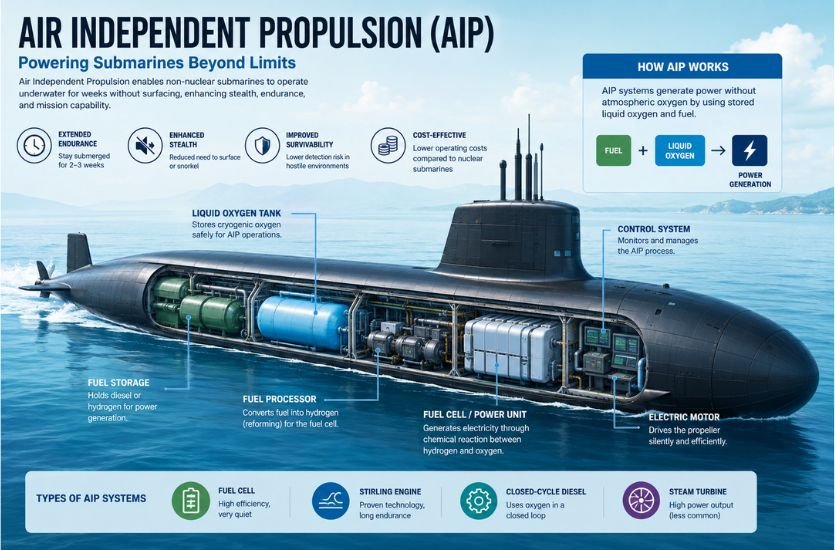
The fundamental principle behind Air Independent Propulsion is relatively straightforward. Rather than relying on oxygen from the atmosphere, the submarine carries its own supply of oxidizer onboard. Most systems store liquid oxygen in specially designed cryogenic tanks.
The stored oxygen reacts with fuel inside specialized power-generation systems. Depending on the design, this process may produce electricity directly through fuel cells or generate mechanical power using external combustion engines or closed-cycle diesel systems. The electricity generated powers electric propulsion motors, onboard electronics, navigation equipment, communication systems, and life-support equipment while also charging the submarine’s batteries.
Because the entire process occurs underwater without requiring outside air, the submarine can remain submerged for significantly longer periods than conventional diesel-electric submarines. This extended endurance enhances operational flexibility while reducing exposure to enemy surveillance.
Types of Air Independent Propulsion Systems
Several different Air Independent Propulsion technologies have been developed over the years, each with unique advantages and engineering approaches.
Fuel cell systems are considered among the most advanced forms of AIP. They generate electricity through an electrochemical reaction between hydrogen and oxygen without combustion. Because there are very few moving parts, fuel cells operate extremely quietly, making submarines equipped with this technology exceptionally difficult to detect. Fuel cells are also highly efficient and produce relatively little heat, further enhancing stealth capabilities. Germany has been a pioneer in deploying fuel-cell-powered submarines, and several other countries have adopted similar technologies.
Another widely used approach is the Stirling engine system. Unlike conventional internal combustion engines, Stirling engines use external combustion to heat a working gas, creating mechanical energy that drives generators. Stored liquid oxygen allows the engine to function underwater for extended periods. Stirling engines are known for their reliability, durability, and efficient fuel consumption. Sweden became one of the earliest adopters of this technology, and Japan also incorporated Stirling engines into several submarine classes before transitioning toward advanced battery technologies.
Closed-cycle diesel engines represent another form of Air Independent Propulsion. These systems modify conventional diesel engines by supplying stored oxygen while recycling exhaust gases. This allows diesel engines to continue operating underwater without atmospheric air. Although these systems benefit from familiar diesel technology, they generally produce more noise and involve greater mechanical complexity than fuel-cell alternatives.
Steam turbine AIP systems have also been explored. These generate steam using stored oxygen and fuel to drive turbines that produce mechanical power. While capable of delivering high output, steam turbine systems are generally larger and noisier than other AIP technologies and have become less common as quieter, more efficient alternatives have emerged.
Key Components of an Air Independent Propulsion System
An Air Independent Propulsion system consists of several sophisticated components working together to produce reliable underwater power. Liquid oxygen storage tanks safely contain cryogenic oxygen required for combustion or chemical reactions. Fuel storage systems hold diesel fuel, hydrogen, ethanol, or other energy sources depending on the specific AIP design.
Fuel processing units may convert liquid fuels into hydrogen for use in fuel cells, while the primary power-generation system transforms chemical energy into electricity or mechanical power. Electric motors propel the submarine, battery systems store excess energy, cooling equipment regulates operating temperatures, and computerized control systems monitor every stage of power production.
These components are carefully integrated to maximize efficiency while minimizing acoustic signatures, ensuring the submarine remains as quiet as possible during underwater operations.
Advantages of Air Independent Propulsion
The greatest advantage of Air Independent Propulsion is its ability to dramatically extend underwater endurance. Conventional diesel-electric submarines often need to surface every few days to recharge batteries, whereas AIP-equipped submarines can remain submerged for two to three weeks depending on operational conditions and mission requirements.
Extended underwater endurance directly enhances stealth. Enemy forces have far fewer opportunities to detect submarines that rarely surface or snorkel. This improved concealment allows submarines to approach hostile coastlines, monitor naval activity, gather intelligence, and perform surveillance missions with much lower detection risks.
Air Independent Propulsion also contributes to quieter operations. Fuel-cell systems, in particular, generate very little mechanical noise because they lack large moving engine components. Reduced noise decreases the chances of detection by advanced sonar systems used in anti-submarine warfare.
Cost effectiveness is another important benefit. Nuclear-powered submarines require complex reactor systems, specialized maintenance facilities, extensive safety measures, and enormous financial investment. AIP-equipped conventional submarines provide many strategic advantages at a fraction of the acquisition and operating costs, making them attractive options for medium-sized naval forces.
AIP technology is especially valuable for coastal defense. Nations with extensive coastlines, strategic shipping routes, or narrow maritime chokepoints can deploy AIP submarines to patrol territorial waters efficiently while maintaining strong deterrence capabilities.
Limitations of Air Independent Propulsion
Despite its many advantages, Air Independent Propulsion does not completely replace nuclear propulsion. One major limitation is endurance. Although AIP significantly extends underwater operation, stored oxygen and fuel eventually become depleted, requiring the submarine to resupply after several weeks. Nuclear submarines, by comparison, can remain submerged for months because their reactors do not depend on stored oxygen for propulsion.
Speed also presents limitations. AIP systems generally provide lower continuous power output than nuclear reactors, making sustained high-speed underwater travel more difficult. During combat situations requiring rapid repositioning, nuclear submarines maintain a distinct advantage.
The installation of Air Independent Propulsion systems also increases submarine complexity. Cryogenic oxygen storage, specialized safety systems, and sophisticated power-generation equipment require careful engineering and regular maintenance. These systems occupy valuable internal space that might otherwise be used for additional weapons, crew accommodations, or fuel storage.
Although less expensive than nuclear propulsion, AIP technology still represents a significant investment compared with traditional diesel-electric submarines.
Air Independent Propulsion Compared with Conventional Diesel-Electric Submarines
Traditional diesel-electric submarines remain highly effective platforms, especially in coastal waters, but they face inherent operational constraints due to battery limitations. Frequent snorkeling exposes them to surveillance and reduces mission flexibility.
Air Independent Propulsion substantially reduces these limitations by extending submerged endurance while preserving the inherent quietness of electric propulsion. As a result, AIP-equipped submarines offer greater survivability, enhanced operational reach, and improved intelligence-gathering capabilities.
For many countries that cannot justify the enormous expense of nuclear-powered fleets, AIP represents an ideal balance between affordability and advanced operational performance.
Air Independent Propulsion Compared with Nuclear Propulsion
Nuclear submarines remain unmatched in terms of endurance, sustained speed, and global deployment capability. Their reactors provide virtually unlimited propulsion energy, allowing months of continuous underwater operation without surfacing.
However, nuclear propulsion comes with significant disadvantages, including extremely high construction costs, complex maintenance requirements, strict safety regulations, and specialized infrastructure.
Air Independent Propulsion offers a practical alternative for nations focused primarily on regional maritime security rather than worldwide naval operations. While AIP submarines cannot equal nuclear vessels in endurance or speed, they often achieve comparable stealth during slow underwater patrols, making them formidable assets in coastal environments.
Countries Using Air Independent Propulsion Technology
Several nations have invested heavily in Air Independent Propulsion technology as part of their naval modernization programs. Germany is widely recognized as a global leader in fuel-cell submarine development, producing highly advanced conventional submarines equipped with efficient AIP systems.
Sweden pioneered the operational use of Stirling engine technology and continues to play an important role in submarine innovation. South Korea has incorporated advanced AIP systems into its modern submarine fleet, strengthening its maritime defense capabilities.
Japan successfully employed Stirling engine technology in earlier submarine classes before gradually transitioning toward high-capacity lithium-ion battery systems. France, China, Pakistan, Singapore, and several other countries have also developed or acquired submarines equipped with Air Independent Propulsion.
India is actively advancing indigenous AIP technology through the Defence Research and Development Organisation. The country’s domestically developed fuel-cell-based AIP system is intended for installation in Kalvari-class submarines during future modernization programs. This initiative supports India’s long-term objective of strengthening self-reliance in advanced defense technologies while enhancing underwater operational capabilities.
The Future of Air Independent Propulsion
Air Independent Propulsion continues to evolve as engineers seek greater efficiency, safety, and endurance. Fuel-cell technology remains a major area of research, with improvements focused on higher energy density, increased reliability, and reduced maintenance requirements.
Hydrogen storage methods are becoming safer and more compact, while advanced fuel reforming technologies allow submarines to generate hydrogen from conventional fuels onboard. Improved liquid oxygen storage systems are also enhancing operational safety and extending mission duration.
Another significant trend involves integrating AIP with high-capacity lithium-ion batteries. Hybrid propulsion systems combine the strengths of both technologies, providing greater flexibility, higher power availability, and extended underwater endurance. Artificial intelligence and advanced automation are also expected to optimize energy management, monitor system health, and improve operational efficiency.
Although battery technology continues to advance rapidly, Air Independent Propulsion remains an essential solution for navies seeking long-duration underwater operations without the financial and technical challenges of nuclear propulsion.
Conclusion
Air Independent Propulsion has fundamentally changed the capabilities of conventional submarines by allowing them to remain underwater for weeks without requiring atmospheric oxygen. This innovation has dramatically improved stealth, extended operational endurance, and enhanced the effectiveness of diesel-electric submarines in modern naval warfare.
Through technologies such as fuel cells, Stirling engines, and closed-cycle diesel systems, AIP provides a practical and affordable alternative to nuclear propulsion for many countries. While it cannot fully match the unlimited endurance and high-speed performance of nuclear-powered submarines, it offers exceptional value for coastal defense, surveillance, intelligence gathering, and regional security operations.
As research continues to produce quieter, more efficient, and increasingly reliable propulsion systems, Air Independent Propulsion will remain a cornerstone of submarine design for years to come. Its ability to combine affordability, stealth, and advanced underwater endurance ensures that AIP-equipped submarines will continue playing a vital role in safeguarding national interests beneath the world’s oceans.