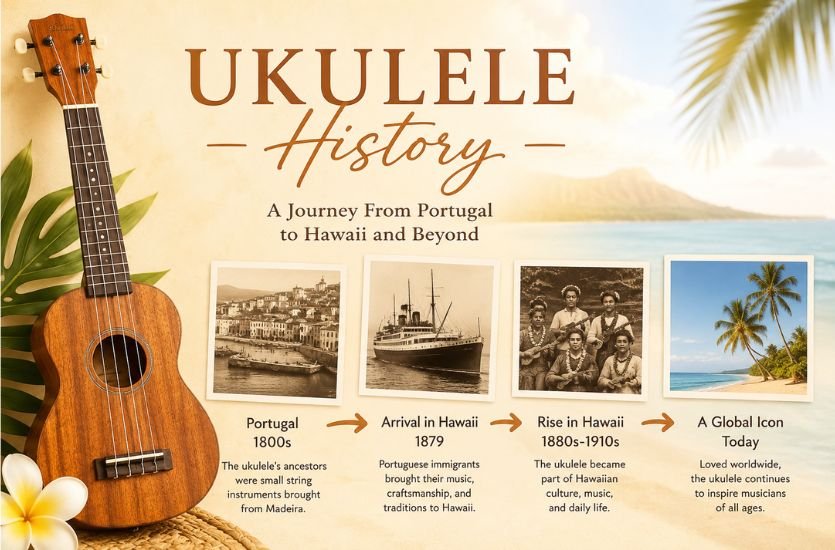

Music has a unique way of preserving stories, traditions, and cultures across generations. Few instruments demonstrate this better than the ukulele, a small four-string instrument whose cheerful sound has won the hearts of millions around the world. Although many people immediately associate it with Hawaii, the story behind its creation stretches far beyond the islands. The history of the ukulele is filled with migration, craftsmanship, cultural exchange, and artistic innovation that transformed a simple folk instrument into a global musical icon.
Today, the ukulele is played by beginners learning their first chords, professional musicians performing on international stages, and enthusiasts who appreciate its warm, inviting tone. Understanding the history of this remarkable instrument provides a deeper appreciation of its cultural importance and explains why it continues to enjoy worldwide popularity more than a century after its creation.
Also Read: 10 Powerful Image Search Techniques
Portuguese Roots: The Beginning of the Story
Long before the ukulele became a symbol of Hawaiian culture, its earliest ancestors were found in Portugal. During the nineteenth century, several small stringed instruments were commonly played on the Portuguese island of Madeira. These included the machete, braguinha, cavaquinho, and rajão. Each featured a compact wooden body and multiple strings, making them ideal for folk music and community celebrations.
The braguinha, sometimes called the machete de braga, is widely considered the closest ancestor of the modern ukulele. Portuguese musicians used these instruments to accompany singing, dancing, and traditional festivals. Their portability, pleasant tone, and relatively simple construction made them popular among ordinary families as well as skilled performers.
At the time, few could have imagined that these humble instruments would eventually inspire one of the world’s most recognizable musical creations.
Portuguese Immigration to Hawaii
The most significant chapter in ukulele history began in 1879 when hundreds of Portuguese immigrants traveled from Madeira to the Hawaiian Islands aboard the ship SS Ravenscrag. These immigrants were recruited primarily to work on Hawaii’s growing sugar plantations, where labor shortages had become a major concern.
Among the passengers were several highly skilled craftsmen, including Manuel Nunes, José do Espírito Santo, and Augusto Dias. These men were not only talented cabinet makers but also experienced instrument builders who brought their woodworking expertise and musical traditions with them.
Soon after arriving in Hawaii, they began constructing instruments similar to those they had built in Portugal. Using locally available Hawaiian woods, they gradually adapted the original designs to suit local tastes and playing styles. These modifications laid the foundation for an entirely new instrument that would soon become closely linked with Hawaiian identity.
The Birth of the Ukulele
Although the ukulele evolved from Portuguese instruments, it quickly developed its own unique personality. Hawaiian craftsmen modified the body shape, adjusted the tuning system, refined the construction techniques, and incorporated native hardwoods such as koa into the manufacturing process.
These improvements produced an instrument that sounded brighter, felt comfortable to play, and perfectly complemented Hawaiian songs and dances. Rather than being a simple copy of the Portuguese braguinha, the ukulele became a distinctly Hawaiian creation shaped by local culture and artistic expression.
Its compact size also contributed to its popularity. The instrument was lightweight, affordable, and easy to carry, making it suitable for family gatherings, beach celebrations, and community events. People of all ages could learn basic chords within a short period, encouraging widespread adoption throughout the islands.
The Meaning Behind the Name
One of the most fascinating aspects of ukulele history involves its unusual name. The word “ukulele” is generally translated from Hawaiian as “jumping flea.”
Several explanations have been offered for this colorful nickname. The most popular theory suggests that a player’s fingers moved rapidly across the strings, resembling the quick movements of a flea. Others believe the energetic motion of the instrument during performances inspired the comparison.
Another historical account suggests the nickname originally referred to an Englishman named Edward Purvis, whose lively personality and energetic performances earned him the nickname “Ukulele.” Over time, the name may have become associated with the instrument itself.
Although historians continue to debate the exact origin, the translation “jumping flea” remains the most widely accepted explanation and has become an enduring part of the instrument’s identity.
King Kalākaua’s Influence on Hawaiian Music
No discussion of ukulele history would be complete without recognizing the influence of King David Kalākaua. Often remembered as the “Merrie Monarch,” he strongly supported Hawaiian arts, music, dance, and cultural traditions during his reign.
King Kalākaua believed that preserving Hawaiian culture was essential to maintaining the kingdom’s identity. He regularly invited musicians to perform at royal celebrations and encouraged the use of the ukulele alongside traditional Hawaiian chants and hula performances.
Royal endorsement dramatically increased the instrument’s popularity. As the ukulele became associated with cultural pride and national celebration, more Hawaiian families embraced it as part of everyday life.
The king’s patronage helped establish the ukulele as one of Hawaii’s defining cultural symbols, a reputation it continues to enjoy today.
Growing Popularity Throughout Hawaii
During the late nineteenth century, the ukulele spread rapidly across the Hawaiian Islands. Its bright, joyful sound made it ideal for accompanying traditional songs, dances, and storytelling.
Families gathered to sing together while children learned their first musical skills using the instrument. Community festivals frequently featured ukulele performances, and local craftsmen continued refining construction methods to improve tone and durability.
Because it required fewer strings than many other instruments and offered relatively simple chord patterns, beginners found it much less intimidating than larger string instruments. This accessibility encouraged widespread participation in music across different generations.
As Hawaiian culture became increasingly recognized by visitors, the ukulele also attracted the attention of travelers who brought stories and instruments back to their home countries.
The World’s Fair That Changed Everything
The international breakthrough for the ukulele came during the Panama-Pacific International Exposition held in San Francisco in 1915.
Hawaii hosted an impressive pavilion showcasing its culture, music, dance, and craftsmanship. Musicians performed traditional Hawaiian songs accompanied by ukuleles, captivating audiences from across the United States and around the world.
Visitors fell in love with the instrument’s distinctive sound and charming appearance. Music publishers quickly responded by producing Hawaiian-themed sheet music, while instrument manufacturers began increasing production to satisfy growing demand.
The exposition effectively introduced the ukulele to mainland America and sparked one of the largest musical crazes of the early twentieth century.
America’s Ukulele Boom
Throughout the 1920s and early 1930s, the ukulele became one of America’s most fashionable musical instruments.
Music stores displayed ukuleles in their windows, schools introduced beginner music programs, and magazines regularly published instructional lessons for new players. Families gathered in living rooms to perform popular songs, while entertainers featured the instrument in vaudeville shows and early radio broadcasts.
Hollywood also contributed to the craze by producing films featuring Hawaiian themes. The cheerful sound of the ukulele became closely associated with tropical vacations, sunshine, and relaxation.
Manufacturers responded by producing millions of affordable instruments, making the ukulele accessible to households across the country.
Decline During the Mid-Twentieth Century
Like many musical trends, the popularity of the ukulele eventually began to fade.
Following World War II, changing musical tastes favored larger instruments such as electric guitars. Rock and roll transformed popular music, while amplified bands dominated radio stations and concert halls.
Although the ukulele never disappeared completely, it gradually became viewed as a children’s instrument or a souvenir purchased by tourists visiting Hawaii.
Even during this quieter period, dedicated musicians continued preserving traditional Hawaiian playing styles while skilled luthiers maintained high standards of craftsmanship.
The Modern Revival
The ukulele experienced an extraordinary revival beginning in the 1990s.
One of the biggest influences was Hawaiian musician Israel Kamakawiwoʻole, whose heartfelt medley of “Somewhere Over the Rainbow” and “What a Wonderful World” introduced millions of listeners to the emotional beauty of the instrument.
Around the same time, the internet transformed music education. Video-sharing platforms allowed beginners to learn chords from home, while online communities connected players from every continent.
Professional performers such as Jake Shimabukuro demonstrated that the ukulele could handle incredibly advanced musical styles, including jazz, classical music, rock, blues, and even complex fingerstyle arrangements.
These performances challenged outdated stereotypes and inspired a new generation of musicians to explore the instrument’s full potential.
Evolution of Ukulele Sizes
As the instrument grew in popularity, manufacturers developed several different sizes to meet varying musical preferences.
The soprano remains the smallest and most traditional version, producing the classic bright Hawaiian sound. The concert ukulele offers slightly more space between frets and a fuller tone, making it comfortable for many players.
The tenor ukulele produces greater volume and deeper resonance, making it popular among professional performers. The baritone, the largest standard model, delivers a richer sound and uses a different tuning that appeals to guitar players transitioning to the ukulele.
Each size offers unique musical characteristics while preserving the friendly personality that defines the instrument.
Materials and Craftsmanship
The quality of a ukulele depends heavily on its construction materials.
Traditional Hawaiian builders favored koa wood because of its attractive grain, durability, and naturally warm sound. Koa remains one of the most respected tonewoods used in premium instruments today.
Mahogany provides balanced warmth and affordability, while spruce tops offer greater projection and clarity. Cedar produces a softer, richer voice preferred by many fingerstyle musicians.
Modern builders combine traditional woodworking methods with advanced manufacturing techniques, allowing both handcrafted and factory-produced ukuleles to reach musicians worldwide.
The Ukulele in Contemporary Music
Modern artists continue expanding the musical possibilities of the ukulele. It appears in pop, folk, jazz, country, indie, and even orchestral performances.
Schools frequently choose the instrument for music education because students can quickly learn basic songs while developing rhythm, coordination, and confidence. Community groups, festivals, and online collaborations have further strengthened the global ukulele community.
Its friendly appearance and approachable learning curve have made it one of the fastest-growing musical instruments of the twenty-first century.
What was once viewed as a simple folk instrument now serves as a powerful creative tool capable of expressing everything from joyful melodies to deeply emotional compositions.
Cultural Importance Beyond Music
The ukulele represents far more than entertainment. It reflects the blending of Portuguese craftsmanship with Hawaiian culture, demonstrating how migration and cultural exchange can create something entirely new.
For Hawaiians, the instrument remains closely connected to family traditions, storytelling, hula, and community celebrations. Around the world, it symbolizes optimism, creativity, and the simple pleasure of making music with others.
Its history reminds us that cultural traditions often grow through collaboration rather than isolation. The ukulele stands as a lasting example of how different communities can contribute to a shared artistic legacy.
Conclusion
The history of the ukulele is a remarkable story of transformation that spans continents and generations. Born from Portuguese folk instruments, refined by skilled craftsmen in Hawaii, embraced by Hawaiian royalty, and eventually celebrated across the globe, the ukulele has earned its place as one of the world’s most beloved musical instruments.
Despite changes in musical trends, technological advances, and shifting cultural tastes, the ukulele continues to inspire musicians of every age and skill level. Its welcoming sound, accessible design, and rich historical background ensure that it remains much more than a small four-string instrument. It is a symbol of cultural exchange, artistic innovation, and the enduring power of music to bring people together, making its legacy as vibrant today as it was more than 140 years ago.