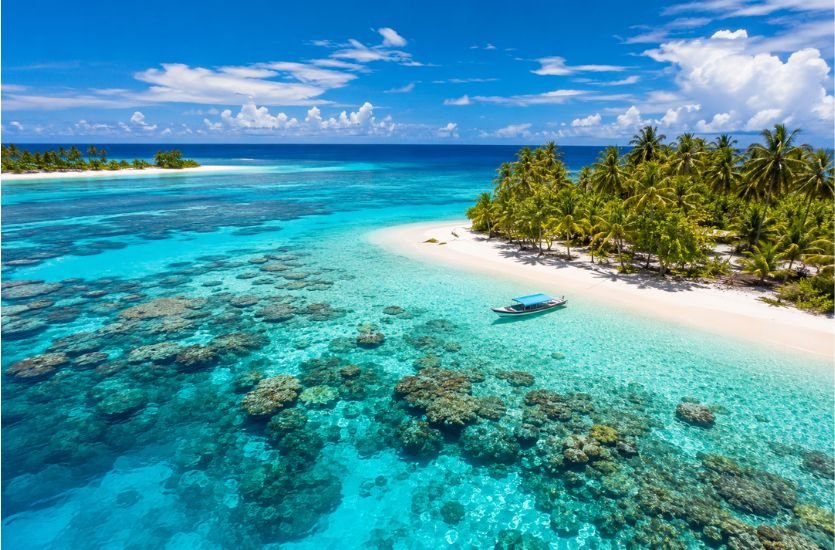

Far from the crowded beaches and famous tourist islands of Indonesia lies a place that remains almost untouched by modern development. Surrounded by crystal-clear waters, vibrant coral reefs, and an astonishing diversity of marine life, Lucipara is one of the country’s best-kept natural secrets. Hidden deep within the Banda Sea, this remote atoll has captivated explorers, marine scientists, divers, and adventure travelers who seek destinations that still preserve their original beauty. While many of Indonesia’s islands have become well-known tourist hotspots, Lucipara continues to exist quietly, protected by its isolation and celebrated for its remarkable ecological richness.
The Lucipara Islands represent more than just another tropical destination. They are an example of how nature can flourish when human impact remains minimal. The islands showcase healthy coral reefs, thriving fish populations, nesting sea turtles, and pristine beaches that have escaped the pressures of mass tourism. Although reaching Lucipara requires determination and careful planning, those who visit often describe it as one of the most rewarding experiences in Indonesia’s vast archipelago.
Also Read: אמריליס יפהפה: A Complete Guide to Growing, Caring for, and Enjoying This Elegant Flower
What Is Lucipara?
Lucipara refers to a small coral atoll located in the Banda Sea within Indonesia’s Maluku Province. Unlike larger inhabited islands across the country, Lucipara consists of a handful of tiny islands surrounded by shallow lagoons and extensive coral reef systems. Its remote location has allowed it to remain largely untouched, making it one of Indonesia’s most pristine marine environments.
The islands are uninhabited or only temporarily visited by fishermen, researchers, and expedition crews. There are no permanent towns, hotels, or commercial developments. Instead, Lucipara offers visitors an authentic glimpse into a natural ecosystem where wildlife dominates the landscape and human activity is minimal.
Although the islands occupy only a small area of land, the surrounding marine ecosystem is exceptionally rich. Much of Lucipara’s true beauty exists beneath the ocean’s surface, where colorful coral formations and abundant marine species create an underwater world that rivals many of the world’s most famous diving destinations.
The Geographic Location of Lucipara
Lucipara lies in the Banda Sea, one of Indonesia’s deepest and most biologically diverse marine regions. Administratively, the islands belong to the Maluku Islands, also known as the Moluccas, an archipelago famous for its historical importance during the global spice trade.
The Banda Sea itself is surrounded by numerous islands and deep ocean basins that create ideal conditions for marine biodiversity. Lucipara’s position places it within the Coral Triangle, a region recognized as the global center of marine biodiversity. Scientists consider this area one of the richest ecosystems on Earth due to the incredible variety of coral species, fish, mollusks, and other marine organisms that inhabit its waters.
Because of its isolation, Lucipara remains difficult to access. This geographical remoteness has played a major role in preserving its natural environment, allowing coral reefs and marine life to thrive without the pressures of heavy tourism or urban development.
A Landscape Defined by Coral and Ocean
Unlike mountainous volcanic islands found elsewhere in Indonesia, Lucipara is primarily a coral atoll formed over thousands of years through natural geological and biological processes. Coral reefs gradually accumulated around submerged volcanic structures, eventually creating low-lying islands surrounded by lagoons and reef flats.
The islands themselves feature soft white sand, tropical vegetation, coconut palms, and shrubs adapted to coastal conditions. Their elevation above sea level is relatively low, making the surrounding ocean the defining feature of the landscape.
The lagoons display stunning shades of turquoise and blue, while the surrounding reef creates natural protection from powerful ocean waves. During calm weather, the water becomes exceptionally clear, allowing visibility that often extends for several dozen meters below the surface.
This remarkable clarity makes Lucipara especially attractive for underwater photography, scientific research, and marine exploration.
Historical Significance of Lucipara
Although Lucipara never developed into a major settlement, it has long appeared on maritime charts used by sailors navigating the Banda Sea. During the Age of Exploration, European navigators traveling between the Spice Islands frequently relied on remote islands such as Lucipara for navigation.
The Banda Sea served as an important route connecting the valuable spice-producing islands of the Maluku region with international trade networks. Dutch, Portuguese, and later British ships sailed through these waters while transporting cloves, nutmeg, and mace, commodities that once shaped global commerce.
Lucipara itself was never heavily populated because its limited freshwater resources and small land area made permanent settlement difficult. Instead, it became recognized primarily as a geographical landmark for mariners crossing one of Indonesia’s vast marine regions.
Today, the islands continue to hold historical value while gaining greater recognition for their ecological importance rather than their role in maritime trade.
Rich Marine Biodiversity
The greatest treasure of Lucipara lies beneath its surrounding waters. Marine biologists regard the area as one of Indonesia’s healthiest reef ecosystems due to its relatively untouched condition.
The coral reefs support an extraordinary variety of marine life, including hundreds of reef fish species that depend upon healthy coral habitats for food and shelter. Schools of colorful fish swim among branching corals, while larger predatory species patrol deeper reef slopes.
Sea turtles frequently visit Lucipara, using nearby beaches as nesting sites and surrounding waters as feeding grounds. Reef sharks, rays, giant trevally, dogtooth tuna, groupers, snappers, and countless smaller fish species contribute to the area’s impressive biodiversity.
Soft corals add movement and color to the underwater landscape, while hard corals create complex reef structures that provide homes for countless marine organisms. Crustaceans, mollusks, sea stars, and numerous invertebrates further enrich this remarkable ecosystem.
Because commercial fishing pressure remains relatively low compared to other regions, fish populations continue to thrive in numbers rarely seen near heavily populated coastlines.
Lucipara Within the Coral Triangle
Lucipara occupies a strategic location within the Coral Triangle, an internationally recognized marine region encompassing parts of Indonesia, Malaysia, the Philippines, Papua New Guinea, Timor-Leste, and the Solomon Islands.
Scientists often describe the Coral Triangle as the “Amazon of the Seas” because of its extraordinary concentration of marine biodiversity. More than seventy-five percent of the world’s coral species occur within this region, alongside thousands of fish species and countless marine invertebrates.
Lucipara contributes significantly to this biodiversity by preserving coral reefs that remain largely free from destructive coastal development. Healthy reefs not only support marine wildlife but also play an essential role in maintaining ocean ecosystems throughout the wider Banda Sea.
Researchers continue studying Lucipara’s reefs to better understand coral resilience, reef recovery, and the long-term effects of climate change on tropical marine ecosystems.
A Dream Destination for Divers
For experienced scuba divers, Lucipara represents one of Indonesia’s most rewarding yet least crowded dive destinations. The absence of mass tourism allows divers to explore reef systems that remain exceptionally healthy and vibrant.
Underwater visibility is often excellent due to the area’s clean oceanic waters. Divers encounter dramatic coral walls, expansive coral gardens, sandy channels, and deep blue drop-offs where larger pelagic species frequently appear.
Reef sharks glide gracefully through the water while schools of jacks, barracudas, and tuna circle nearby. Sea turtles move slowly above coral formations, and colorful reef fish create constantly changing patterns throughout the underwater landscape.
Macro photographers also appreciate Lucipara’s smaller marine creatures, including nudibranchs, shrimp, crabs, and other fascinating reef inhabitants that reveal the ecosystem’s incredible complexity.
Because diving conditions depend heavily on weather and ocean currents, most visitors join organized liveaboard expeditions led by experienced dive professionals familiar with the region.
Sport Fishing Opportunities
Lucipara has also earned international recognition among sport-fishing enthusiasts seeking challenging offshore species. Deep surrounding waters provide habitat for powerful game fish that attract anglers from around the world.
Species such as giant trevally, yellowfin tuna, dogtooth tuna, Spanish mackerel, grouper, and snapper are commonly found in the region. The combination of healthy reefs and deep ocean currents creates ideal feeding conditions for these highly prized fish.
Responsible fishing practices are increasingly encouraged to ensure that Lucipara’s marine ecosystems remain sustainable for future generations while allowing recreational anglers to continue enjoying this extraordinary environment.
Wildlife Beyond the Reef
Although marine life receives most attention, Lucipara’s terrestrial wildlife also deserves recognition. The islands provide resting and nesting habitats for numerous seabird species that depend upon isolated islands free from predators and human disturbance.
Sea turtles return seasonally to lay eggs on sandy beaches, continuing natural reproductive cycles that have existed for countless generations. Coconut crabs, one of the world’s largest terrestrial arthropods, may also inhabit suitable island environments within the region.
Native coastal vegetation helps stabilize sandy soils while providing habitat for insects, reptiles, and migratory birds. The interaction between land and sea creates an interconnected ecosystem in which each component supports the others.
Conservation Challenges
Despite its isolation, Lucipara is not immune to environmental threats. Climate change presents one of the greatest long-term risks facing coral reefs worldwide. Rising ocean temperatures can trigger coral bleaching events, reducing reef health and biodiversity.
Ocean acidification also threatens coral growth by altering seawater chemistry essential for coral skeleton formation. Even remote ecosystems such as Lucipara may experience these global environmental pressures.
Illegal fishing methods, including destructive practices such as blast fishing and cyanide fishing, pose additional risks if enforcement becomes inadequate. Fortunately, Lucipara’s remoteness has limited many of these impacts compared to more accessible reef systems.
Marine conservation organizations and Indonesian authorities increasingly recognize the importance of protecting healthy reef ecosystems like Lucipara as part of broader efforts to conserve biodiversity across the Coral Triangle.
Visiting Lucipara
Traveling to Lucipara requires careful planning because regular transportation services do not exist. Most visitors begin their journey by flying to major Indonesian cities before connecting to Ambon or other regional airports in Maluku.
From there, access usually involves joining specialized liveaboard expeditions or research vessels capable of reaching the remote islands safely. Depending on weather conditions and departure points, sea journeys may require many hours or even several days.
Visitors should understand that Lucipara offers no tourism infrastructure. There are no resorts, restaurants, shopping centers, or medical facilities. Everything needed for the journey must be carried aboard the expedition vessel.
This absence of development is precisely what makes Lucipara so appealing. Travelers experience nature in its purest form without crowds, commercial attractions, or urban distractions.
Why Lucipara Matters
Lucipara represents far more than an isolated group of tropical islands. It serves as a living example of what healthy marine ecosystems can look like when protected from excessive human impact. Its thriving coral reefs demonstrate the resilience of nature while highlighting the importance of responsible environmental stewardship.
For scientists, Lucipara offers valuable opportunities to study coral reef ecology, marine biodiversity, and climate resilience. For divers and photographers, it provides unforgettable encounters with some of Indonesia’s most spectacular underwater landscapes. For conservationists, it stands as a reminder that preserving remote ecosystems remains essential for maintaining global biodiversity.
As awareness grows about the ecological significance of the Banda Sea, Lucipara may become increasingly recognized as one of Indonesia’s most important natural treasures. Protecting its reefs, wildlife, and pristine environment will require continued cooperation between researchers, conservation organizations, government agencies, and responsible visitors.
Conclusion
Lucipara remains one of Indonesia’s last truly hidden marine paradises, where untouched coral reefs, crystal-clear waters, and extraordinary biodiversity continue to flourish far from the pressures of modern development. Its remote location has preserved an ecosystem that offers invaluable scientific, ecological, and recreational benefits while showcasing the incredible richness of the Coral Triangle.
Although reaching Lucipara demands time, effort, and careful planning, the reward is an experience unlike any other. Visitors encounter a world where nature remains largely unchanged, marine life thrives in remarkable abundance, and the beauty of the Banda Sea unfolds in its purest form. As global attention increasingly focuses on marine conservation, Lucipara stands as both a symbol of hope and a reminder that some of Earth’s greatest treasures are those that remain carefully protected for generations to come.