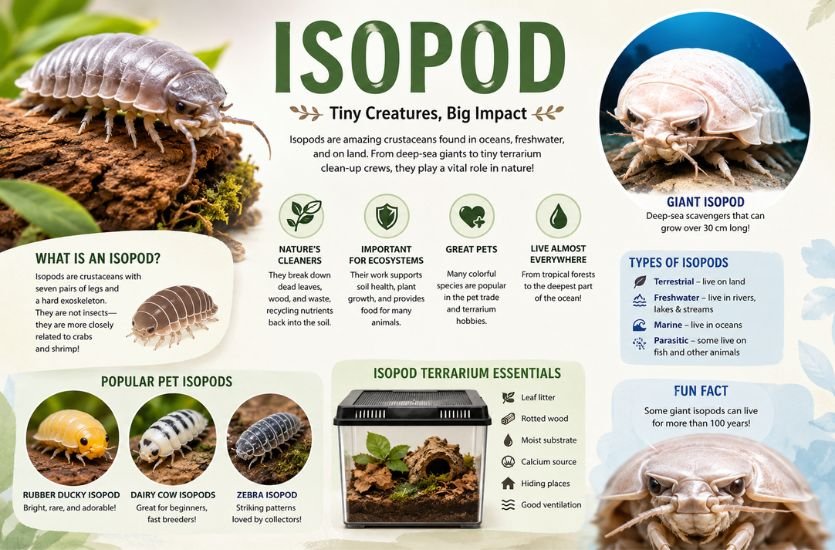
What Is an Isopod? Giant, Deep-Sea, Food, Terrariums, Rubber Ducky Isopods, Dairy Cow Isopods, and Care

Life thrives in places where few creatures dare to survive, from damp forest floors covered in fallen leaves to the crushing darkness of the deepest oceans. Among the remarkable animals that have mastered these vastly different environments is the isopod. Although many people recognize the small pill bugs that roll into balls in their gardens, few realize they belong to a much larger and more diverse family that includes enormous deep-sea scavengers, colorful exotic pets, and species prized by terrarium enthusiasts around the world.
Also Read: Landbouw Economisch Instituut: The Foundation of Agricultural Economic Research in the Netherlands
The incredible diversity of isopods has made them increasingly popular among nature lovers, hobbyists, and scientists alike. Their ability to recycle organic matter, maintain healthy ecosystems, and adapt to nearly every habitat on Earth makes them one of the most successful groups of crustaceans. Whether you are curious about a giant isopod lurking thousands of feet beneath the ocean’s surface or a rare rubber ducky isopod living in a carefully maintained terrarium, there is always something new to discover about these fascinating creatures.
What Is an Isopod?
If you have ever wondered what is an isopod, the simplest answer is that an isopod is a crustacean belonging to the order Isopoda. Unlike insects, isopods are closely related to shrimp, crabs, and lobsters. Scientists have identified more than 10,000 species, with many more believed to remain undiscovered, particularly in the deep sea.
The word “isopod” comes from Greek, meaning “equal foot,” referring to the similar appearance of their seven pairs of walking legs. Although species vary dramatically in size and color, most share several defining characteristics, including a segmented body, a hard exoskeleton, two antennae, and multiple pairs of legs designed for crawling rather than swimming.
Many people know terrestrial isopods as pill bugs, woodlice, or roly-polies. These familiar garden inhabitants represent only a small fraction of the enormous diversity found within the order Isopoda.
The Incredible Diversity of Isopods
One of the most fascinating aspects of isopods is their ability to occupy almost every aquatic and terrestrial environment imaginable. They have evolved to survive in tropical rainforests, temperate woodlands, freshwater rivers, coral reefs, rocky shorelines, and even the deepest parts of the ocean.
Marine species make up the majority of all known isopods. Some inhabit shallow coastal waters while others spend their lives in the darkness of ocean trenches several thousand meters below the surface.
Freshwater species live in lakes, rivers, underground caves, and springs where moisture remains constant throughout the year.
Terrestrial isopods have adapted to life on land by developing specialized respiratory structures that allow them to breathe while remaining dependent on humid environments. This is why they are commonly found beneath logs, stones, leaf litter, and garden mulch where moisture levels remain high.
Anatomy and Physical Characteristics
Although different species vary in appearance, most isopods share a recognizable body plan. Their bodies consist of a head, thorax, and abdomen protected by a hard armored exoskeleton made primarily of chitin and calcium compounds.
The head contains compound eyes and two pairs of antennae used to detect food, moisture, and potential threats. Seven pairs of legs extend from the thorax, providing remarkable mobility over uneven terrain.
Many terrestrial species can curl into a nearly perfect ball when threatened. This defensive behavior protects their softer underside from predators and helps reduce water loss. Species capable of this behavior are often called pill bugs, while others remain flat and rely on speed or camouflage instead.
Marine isopods possess additional appendages that help with respiration and swimming, although many are primarily bottom-dwelling scavengers.
Where Do Isopods Live?
The remarkable adaptability of isopods allows them to occupy habitats across every continent except Antarctica.
Forest ecosystems provide ideal conditions for terrestrial species because moist soil and decomposing vegetation create an abundant food supply. They spend daylight hours hiding beneath logs, bark, rocks, and dense leaf litter before emerging at night to forage.
In freshwater environments, isopods inhabit streams, ponds, wetlands, and caves where they consume organic debris that accumulates along the bottom.
The isopod sea environment is even more diverse. Marine isopods inhabit coral reefs, sandy seabeds, kelp forests, rocky coastlines, estuaries, and the deep ocean floor. Some species live among seaweed while others burrow into sediment or attach themselves to fish.
Perhaps the most extraordinary marine habitat belongs to deep-sea species living thousands of feet below the surface, where sunlight never reaches and food is scarce.
Giant Isopod: The King of the Deep Ocean
No discussion of isopods is complete without mentioning the legendary giant isopod. Belonging primarily to the genus Bathynomus, these extraordinary animals have become icons of deep-sea biology.
Unlike the tiny garden isopods that measure only a few millimeters long, giant isopods can exceed 30 centimeters in length, with exceptionally large individuals approaching half a meter. Their impressive size results from a phenomenon known as deep-sea gigantism, where animals living in cold, high-pressure environments often grow much larger than their shallow-water relatives.
Their appearance resembles an oversized pill bug covered in thick gray armor. Large compound eyes help them detect movement in the darkness, while powerful legs and claws allow them to crawl across the ocean floor searching for food.
Despite their intimidating appearance, giant isopods are primarily scavengers rather than active hunters. They consume dead fish, squid, whales, and virtually any organic material that sinks to the seabed.
One of their most remarkable adaptations is their ability to survive without food for months or even years. Because meals are unpredictable in the deep ocean, giant isopods store energy efficiently and dramatically slow their metabolism during periods of starvation.
Deep Sea Isopod Adaptations
The deep sea isopod represents one of nature’s greatest survival stories. Living at depths exceeding several thousand feet exposes these animals to crushing pressure, near-freezing temperatures, and complete darkness.
To survive, they have evolved exceptionally slow metabolic rates that minimize energy consumption. Their heavy exoskeleton withstands immense pressure while specialized sensory organs help locate food in total darkness.
Food sources are rare in the deep sea, so these scavengers consume nearly anything edible they encounter. Whale carcasses, dead fish, squid, crustaceans, and organic debris all become valuable meals.
Scientists continue discovering new deep-sea isopod species during ocean expeditions, suggesting that much of their diversity remains unknown.
Rubber Ducky Isopod: The Celebrity of the Terrarium World
Among exotic pet enthusiasts, few species generate as much excitement as the rubber ducky isopod. This highly sought-after variety belongs to the genus Cubaris and earned its nickname because its yellow face resembles a miniature rubber duck.
Native to limestone cave systems in Southeast Asia, rubber ducky isopods require warm temperatures, consistently high humidity, and calcium-rich environments to thrive. Their specialized care requirements make them more challenging than many beginner species.
Their unusual appearance, limited availability, and relatively slow reproduction have made them one of the most expensive pet isopods available. Collectors often pay premium prices for healthy breeding colonies.
Beyond their rarity, rubber ducky isopods display fascinating behaviors, spending much of their time exploring moss, bark, and decaying wood within carefully designed enclosures.
Dairy Cow Isopods: Perfect for Beginners
At the opposite end of the difficulty spectrum are dairy cow isopods, one of the most popular species for beginners entering the hobby.
These striking isopods belong to Porcellio laevis and are instantly recognizable by their white bodies decorated with irregular black patches that resemble the markings of dairy cattle.
Their popularity comes from several advantages. They grow relatively large, reproduce quickly, tolerate a wide range of environmental conditions, and eagerly consume leftover organic matter. These characteristics make them excellent additions to bioactive reptile and amphibian enclosures.
Dairy cow isopods are also highly active compared to many other species, allowing keepers to observe their natural behaviors more frequently. Their rapid breeding makes them ideal for establishing self-sustaining cleanup crews in vivariums.
Why Isopods Matter in Nature
Despite their small size, isopods perform enormous ecological services. They function primarily as decomposers, breaking down dead leaves, wood, fungi, and other organic material into nutrients that plants can reuse.
Without these tiny recyclers, forests would accumulate massive quantities of undecomposed plant matter, slowing nutrient cycling and reducing soil fertility.
Their feeding activities also improve soil structure by increasing aeration and encouraging microbial growth. Countless organisms benefit indirectly from their work, making isopods an essential component of healthy ecosystems.
In addition, isopods serve as prey for birds, reptiles, amphibians, spiders, beetles, centipedes, and small mammals. Their position within the food web supports countless predators across terrestrial and aquatic environments.
Isopod Food: What Do Isopods Eat?
One of the reasons isopods are considered nature’s cleanup crew is their incredibly varied diet. Most terrestrial species are detritivores, meaning they feed primarily on decaying organic matter rather than living plants. This feeding behavior helps recycle nutrients back into the soil while reducing the buildup of decomposing material in forests and gardens.
The most important component of isopod food is leaf litter. Dried oak, maple, magnolia, and beech leaves provide both nutrition and shelter, making them essential in both wild habitats and captive enclosures. Rotting wood is another staple, offering cellulose and beneficial microorganisms that aid digestion.
In captivity, keepers often supplement their diets with vegetables such as carrots, zucchini, squash, cucumber, sweet potatoes, mushrooms, and pumpkin. These fresh foods provide additional vitamins and moisture while encouraging active feeding behavior.
Protein is equally important, particularly for rapidly growing or breeding colonies. Fish flakes, shrimp pellets, dried mealworms, freeze-dried shrimp, and high-quality insect food are commonly offered in moderation. Too much protein, however, can lead to excessive population growth or encourage aggressive competition among certain species.
Calcium is another essential dietary requirement because isopods constantly rebuild their exoskeletons during molting. Cuttlebone, crushed eggshells, oyster shell, and powdered calcium are frequently added to enclosures to ensure healthy shell development.
Marine isopods consume a different range of foods depending on their habitat. Many species scavenge dead fish, marine algae, seaweed, mollusks, crustaceans, and other decaying organisms that settle on the ocean floor. Giant isopods are especially famous for consuming whale falls and other large carcasses that sink into the deep ocean.
Building the Perfect Isopod Terrarium
The growing popularity of exotic isopods has led many hobbyists to create carefully designed enclosures that replicate natural habitats. A well-maintained isopod terrarium not only keeps the animals healthy but also allows observers to enjoy their fascinating behaviors.
Most hobbyists use plastic storage containers or glass terrariums with secure lids and proper ventilation. The enclosure should maintain consistent humidity while allowing enough airflow to prevent mold growth.
The substrate forms the foundation of the habitat and usually consists of organic topsoil, coconut fiber, decayed wood, sphagnum moss, and crushed leaf litter. This mixture retains moisture while providing food and hiding places.
Cork bark, rotting logs, moss patches, and pieces of bark create shelters where isopods spend much of their day resting. Since these animals naturally avoid bright light, plenty of hiding spots help reduce stress.
Humidity should remain relatively high, with one side of the enclosure kept slightly wetter than the other. This moisture gradient allows isopods to regulate their hydration by moving between damp and drier areas as needed.
Temperatures between 68°F and 80°F (20°C to 27°C) are suitable for most commonly kept species, although tropical varieties such as the rubber ducky isopod often prefer slightly warmer conditions.
Why Isopods Are Essential in Bioactive Terrariums
Bioactive enclosures have become increasingly popular among reptile and amphibian keepers because they create miniature self-sustaining ecosystems. Isopods play a vital role in these systems by acting as natural recyclers.
As reptiles, frogs, snakes, and invertebrates produce waste, leftover food and organic debris accumulate within the enclosure. Instead of manually removing every piece of waste, isopods consume much of this material before it can rot or produce harmful bacteria.
Their constant movement also aerates the soil, improving drainage and promoting healthy root systems for live plants. By breaking down organic matter into nutrients, they support beneficial microorganisms that further enhance the enclosure’s ecosystem.
For this reason, dairy cow isopods, powder orange isopods, powder blue isopods, and several Porcellio species are widely regarded as some of the best cleanup crews for bioactive terrariums.
The Life Cycle of Isopods
Although different species mature at different rates, the basic life cycle remains remarkably consistent throughout the order.
Mating typically occurs after females complete a molt, when their new exoskeleton remains soft enough for fertilization. After mating, females carry fertilized eggs inside a specialized brood pouch called a marsupium located beneath the body.
Unlike insects that undergo complete metamorphosis, young isopods hatch as miniature versions of the adults. These tiny offspring already possess most adult features and gradually increase in size through a series of molts.
During growth, isopods periodically shed their exoskeleton. Interestingly, they molt in two stages rather than all at once. The rear half of the body molts first, followed by the front portion several days later. This unusual process reduces vulnerability by ensuring that part of the protective shell remains intact throughout the molt.
Depending on the species and environmental conditions, many terrestrial isopods live between two and four years, while some larger species may survive even longer.
Reproduction and Colony Growth
Healthy colonies can reproduce surprisingly quickly under favorable conditions. Warm temperatures, adequate humidity, abundant food, and consistent calcium availability all encourage breeding.
Fast-reproducing species such as dairy cow isopods can establish thriving colonies within a matter of months. Slower-growing species like the rubber ducky isopod reproduce much more gradually, contributing to their rarity and higher market value.
Population size naturally balances itself according to available food and living space. When conditions become overcrowded or resources decline, reproduction slows until environmental conditions improve.
Common Predators of Isopods
Despite their protective exoskeleton, isopods face numerous predators throughout their lives. Birds regularly search beneath leaves and logs for terrestrial species, while frogs, salamanders, lizards, spiders, beetles, centipedes, and small mammals also rely on them as an important food source.
Marine isopods become prey for fish, octopuses, crabs, sharks, and larger crustaceans. Even giant isopods, despite their considerable size, can fall victim to deep-sea predators capable of breaking through their armored shells.
Their defensive strategies vary by species. Some rely on camouflage, others flee rapidly into leaf litter, while pill bugs curl into tight balls that protect their vulnerable underside.
Isopod Plush: A Surprisingly Popular Trend
The unusual appearance of giant isopods has inspired an unexpected trend in recent years. The isopod plush has become a favorite among marine biology enthusiasts, aquarium visitors, collectors, and fans of quirky animal merchandise.
Many aquariums, particularly in Japan where giant isopods have achieved near-celebrity status, sell plush toys modeled after these fascinating deep-sea creatures. Some designs are highly realistic, featuring segmented bodies and multiple legs, while others emphasize their adorable appearance with oversized eyes and soft fabrics.
Their growing popularity reflects the increasing public fascination with deep-sea life and unusual animals that were once known only to marine scientists.
Amazing Facts About Isopods
Few animals possess as many surprising characteristics as isopods. Giant isopods can survive for exceptionally long periods without eating, an adaptation that allows them to endure the food scarcity of the deep ocean. Their blood appears bluish because it contains hemocyanin rather than the iron-based hemoglobin found in humans.
Some terrestrial species absorb moisture directly from humid air using specialized body structures, helping them survive in environments where standing water is unavailable. Others communicate using chemical signals that help locate mates and suitable habitats.
Scientists continue discovering entirely new species in remote caves, tropical forests, and unexplored sections of the ocean floor. Each discovery reveals additional evidence of how adaptable and diverse these crustaceans truly are.
Conservation and Future Research
Most common terrestrial isopods remain widespread and abundant, benefiting from their remarkable adaptability. However, certain specialized species face increasing threats from habitat destruction, pollution, climate change, and invasive organisms.
Deep-sea species remain particularly mysterious because only a tiny fraction of the ocean floor has been thoroughly explored. Advances in underwater technology continue revealing new species that challenge previous assumptions about deep-sea biodiversity.
Researchers also study isopods for their potential contributions to soil ecology, environmental monitoring, evolutionary biology, and even space research, as their resilience makes them valuable organisms for scientific investigation.
Conclusion
From the tiny woodlice hiding beneath garden stones to the enormous giant isopods roaming the ocean floor, isopods represent one of the most extraordinary groups of crustaceans on Earth. Their incredible diversity, adaptability, and ecological importance have earned them recognition among scientists, hobbyists, and wildlife enthusiasts alike.
Whether admired as colorful pets, trusted as bioactive terrarium cleanup crews, or studied as deep-sea marvels, isopods continue to captivate people around the world. Understanding what is an isopod reveals far more than the story of a small crustacean—it highlights the remarkable complexity of life itself. Every fallen leaf recycled by terrestrial isopods enriches the soil, while every deep sea isopod scavenging the ocean floor contributes to one of Earth’s most mysterious ecosystems. From the charming rubber ducky isopod and beginner-friendly dairy cow isopods to the iconic giant isopod, these resilient creatures demonstrate how even the smallest animals can play an enormous role in maintaining the balance of nature.