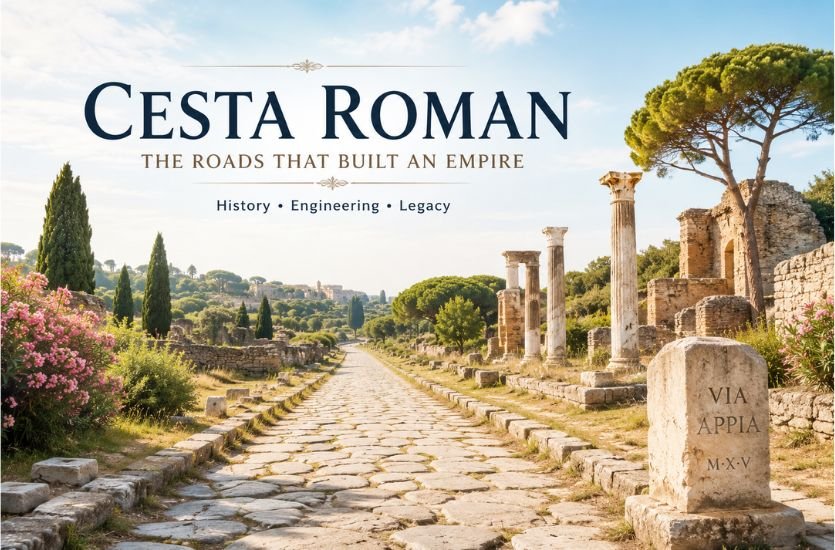

Introduction
Great civilizations are often remembered for their towering monuments, remarkable architecture, and influential leaders, but one of the greatest achievements of Ancient Rome stretched far beyond its cities. Thousands of miles of carefully engineered roads formed the backbone of an empire that ruled vast territories across Europe, North Africa, and the Middle East. Today, many people search for the term cesta roman while trying to understand this incredible transportation network and its lasting impact on history.
Although cesta roman is not an official Latin phrase, it has become a modern search term associated with Roman roads and the remarkable engineering behind them. The proper Latin expression for Roman roads is Viae Romanae, yet the keyword has gained popularity on blogs and search engines because it combines words that resemble “Roman road” in several European languages. Regardless of its linguistic origin, the phrase leads readers to one of history’s most fascinating achievements: the road system that transformed the Roman Empire into one of the world’s most powerful civilizations.
The Roman road network was much more than a collection of pathways connecting cities. It served as the foundation for military campaigns, commercial expansion, political administration, and cultural exchange. Even after nearly two thousand years, many Roman roads continue to influence modern transportation routes, proving that exceptional engineering can stand the test of time.
What Does Cesta Roman Mean?
The phrase cesta roman does not appear in classical Latin literature or official Roman historical records. Instead, it is widely understood as an internet search term referring to Roman roads. The word “cesta” resembles the Slavic term for “road” or “path,” while “Roman” naturally refers to Ancient Rome. Together, the phrase has become associated with the famous roads constructed throughout the Roman Empire.
Understanding this distinction is important because some online sources mistakenly connect the keyword to unrelated Roman artifacts or historical topics. Most users searching for cesta roman are interested in learning about Roman transportation, road construction, engineering innovations, and the influence these roads had on history.
The popularity of the keyword reflects growing curiosity about Ancient Rome and its engineering accomplishments. Roman roads remain among the most studied infrastructure projects in history, admired by engineers, historians, and travelers alike.
The Birth of the Roman Road Network
The expansion of Rome depended heavily on efficient transportation. During the early years of the Roman Republic, military forces needed reliable routes to move quickly between settlements and defend newly conquered territories. Dirt paths proved unreliable, especially during heavy rain, making organized road construction a necessity rather than a luxury.
One of the earliest and most famous Roman roads was the Via Appia, commonly known as the Appian Way. Built in 312 BCE under the direction of Appius Claudius Caecus, this road connected Rome with southern Italy. It quickly demonstrated how permanent roads could improve military mobility while encouraging trade and communication.
As Roman influence expanded across continents, thousands of additional roads were constructed. The network eventually connected Britain in the northwest with modern-day Iraq in the east, allowing Rome to administer one of the largest empires in history with remarkable efficiency.
Roman Engineering Excellence
Roman engineers approached road construction with precision and long-term planning. Unlike simple dirt trails, Roman roads were designed to remain functional for generations. Their durability continues to impress modern civil engineers who study ancient construction methods.
The construction process began with careful surveying. Engineers selected the most practical route while minimizing steep slopes and unnecessary curves. Straight roads reduced travel time and simplified navigation, even if they required bridges, embankments, or significant excavation.
Once the route had been determined, workers excavated the ground and created a strong foundation using large stones. Above this base, successive layers of gravel, crushed rock, and sand provided stability. Finally, large paving stones formed the road’s durable surface.
Drainage represented one of the greatest strengths of Roman engineering. Roads were slightly elevated in the center so rainwater naturally flowed toward drainage ditches along both sides. This prevented standing water from weakening the foundation and significantly increased the road’s lifespan.
Many surviving Roman roads continue to demonstrate the effectiveness of these construction techniques, with some sections remaining usable after nearly two millennia.
Why Roman Roads Were So Important
Roads transformed nearly every aspect of Roman society. Their importance extended well beyond transportation, influencing military strategy, economics, politics, and everyday life.
Military efficiency was perhaps the greatest advantage. Roman legions could travel rapidly across vast territories, allowing the empire to respond quickly to invasions, suppress rebellions, and reinforce distant frontiers. Fast troop movement gave Rome a significant strategic advantage over many opponents.
Trade flourished because merchants could transport goods more safely and efficiently than ever before. Agricultural products, pottery, textiles, metals, wine, olive oil, and luxury goods moved between provinces, strengthening local economies while enriching the empire as a whole.
Government administration also became more effective. Officials, tax collectors, messengers, and couriers relied on the road network to communicate across thousands of miles. Information that once required weeks could now reach distant provinces much more quickly.
The roads also encouraged cultural exchange. Travelers carried languages, religious beliefs, artistic traditions, scientific knowledge, and technological innovations throughout the empire. This movement of ideas helped shape European civilization for centuries.
How Roman Roads Were Built
Constructing a Roman road required enormous planning, skilled labor, and substantial financial investment. Engineers followed standardized methods that emphasized durability over speed.
Workers first cleared vegetation and excavated the desired route. The depth of excavation depended on local soil conditions, ensuring that weak ground would not compromise the road’s stability.
Large foundation stones created a solid base capable of supporting heavy traffic. Layers of gravel and crushed stone were compacted above the foundation to improve strength while allowing water to drain effectively.
The surface consisted of tightly fitted paving stones carefully arranged to create a smooth yet durable roadway. Skilled stonecutters shaped each block to minimize gaps, producing roads that resisted erosion and required relatively little maintenance.
Roads often included drainage ditches, retaining walls, bridges, culverts, and milestones. Milestones marked distances from Rome or other major cities, helping travelers estimate journey times while reinforcing the empire’s administrative organization.
Famous Roman Roads
Several Roman roads achieved lasting historical significance because of their strategic importance and remarkable construction quality.
The Via Appia became known as the “Queen of Roads” due to its role in connecting Rome with southern Italy. It supported military campaigns while stimulating regional commerce and remains one of the most celebrated roads in history.
The Via Aurelia connected Rome with northwestern Italy along the Mediterranean coast, serving both military and commercial purposes. Portions of its route influenced later European highways.
The Via Flaminia linked Rome with the Adriatic coast, facilitating trade and military movement between central Italy and northern provinces.
The Via Egnatia extended across the Balkans, connecting the Adriatic Sea with Byzantium. This important international route later became valuable during both the Byzantine and Ottoman periods, illustrating the remarkable longevity of Roman infrastructure.
These roads formed only a small portion of a network that eventually exceeded tens of thousands of miles, connecting cities, military forts, ports, and frontier settlements across three continents.
Daily Life Along Roman Roads
Roman roads supported millions of ordinary people, not just soldiers and government officials. Farmers transported crops to nearby markets, merchants visited distant provinces, craftsmen sold their products across regions, and travelers explored unfamiliar territories.
Roadside inns provided food, lodging, and supplies for weary travelers. Horse-changing stations enabled government couriers to maintain impressive travel speeds, while local marketplaces developed around busy transportation hubs.
Pilgrims visited religious sites, scholars exchanged knowledge, and entertainers traveled between cities performing for diverse audiences. Roads became channels through which people, ideas, goods, and cultures continuously flowed.
The increased mobility also encouraged urban development. Towns situated along major roads often experienced rapid economic growth as travelers purchased food, accommodations, tools, clothing, and transportation services.
Roman Roads and Military Power
Military success depended heavily on logistics, and Roman roads revolutionized military operations. Well-trained legions could march long distances while maintaining organized supply lines and reliable communication.
Roads enabled commanders to reinforce threatened borders quickly without relying entirely on rivers or coastal shipping. During campaigns, soldiers could transport weapons, food, medical supplies, engineering equipment, and siege machinery far more efficiently than armies using unprepared routes.
Permanent roads also simplified the construction and maintenance of frontier defenses. Forts positioned along important roads formed interconnected security networks capable of responding rapidly to external threats.
Many historians believe that Rome’s extensive road system played a major role in maintaining imperial control for centuries, allowing the government to project power across enormous distances.
The Lasting Influence of Roman Roads
Although the Western Roman Empire eventually declined, many Roman roads remained in continuous use throughout the Middle Ages and beyond. Later civilizations recognized their value and maintained or expanded existing routes instead of constructing entirely new transportation networks.
Numerous modern highways in Italy, France, Spain, Britain, Germany, and other European countries closely follow ancient Roman alignments. Engineers often discovered that Roman surveyors had already selected the most practical routes through difficult terrain.
Modern civil engineering continues to admire Roman construction principles, particularly the emphasis on strong foundations, effective drainage, and careful route planning. While today’s roads use advanced materials such as asphalt and reinforced concrete, many fundamental engineering concepts remain remarkably similar.
Roman roads also contribute significantly to archaeological research. Excavated road sections provide valuable information about ancient construction techniques, trade patterns, settlement development, and military strategy.
Visiting Roman Roads Today
Many preserved Roman roads have become popular tourist destinations where visitors can experience ancient history firsthand. Walking along original stone pavements offers a unique perspective on the journeys once undertaken by soldiers, merchants, emperors, and ordinary citizens.
The Appian Way near Rome remains one of the world’s best-preserved Roman roads. Visitors can explore ancient tombs, monuments, aqueducts, and sections of the original pavement while imagining the bustling traffic that once connected Rome with distant provinces.
Roman roads can also be found throughout Spain, France, England, Croatia, Turkey, and several other countries that once formed part of the empire. Archaeological parks, museums, and historical trails help preserve these remarkable engineering achievements for future generations.
These surviving roads continue attracting historians, engineers, travelers, photographers, and students interested in understanding one of humanity’s greatest infrastructure accomplishments.
Common Misunderstandings About Cesta Roman
Because the keyword cesta roman has gained popularity through internet searches rather than historical literature, misunderstandings occasionally arise. Some websites incorrectly associate it with unrelated Roman artifacts or confuse it with the ancient Roman boxing glove known as the caestus.
The overwhelming search intent, however, points toward Roman roads and transportation infrastructure. Readers looking for information about cesta roman are generally seeking historical knowledge about how Rome built, maintained, and utilized its extraordinary road network.
Recognizing this distinction helps readers avoid misinformation while appreciating the genuine historical achievements associated with Roman engineering.
Why Cesta Roman Still Fascinates People
Modern fascination with Roman roads reflects admiration for human ingenuity. Constructed without modern machinery, computerized surveying equipment, or advanced construction materials, these roads continue demonstrating exceptional durability and intelligent design.
Their influence extends beyond engineering. Roman roads shaped commerce, politics, culture, military strategy, urban planning, and international communication. They connected diverse civilizations under a single administrative system while encouraging the exchange of ideas that helped shape Western history.
Every preserved section serves as a reminder that thoughtful planning, quality craftsmanship, and long-term vision can produce infrastructure capable of lasting thousands of years.
Conclusion
The growing popularity of the keyword cesta roman highlights enduring interest in one of history’s greatest engineering accomplishments. Although the phrase itself is not an official Latin term, it has become closely associated with the remarkable Roman road network that connected an empire spanning three continents.
Roman roads were far more than transportation routes. They enabled military victories, strengthened economies, facilitated communication, encouraged cultural exchange, and supported the administration of one of the ancient world’s largest empires. Their advanced construction methods continue inspiring engineers and historians who study infrastructure built to endure the passage of time.
Walking along surviving Roman roads today offers more than a glimpse into the past. It provides tangible evidence of how intelligent design, skilled craftsmanship, and ambitious planning can leave a legacy that survives for millennia. Whether encountered through archaeological sites, modern highways following ancient routes, or historical research inspired by the term cesta roman, these roads remain enduring symbols of Roman innovation and the extraordinary achievements of one of history’s most influential civilizations.