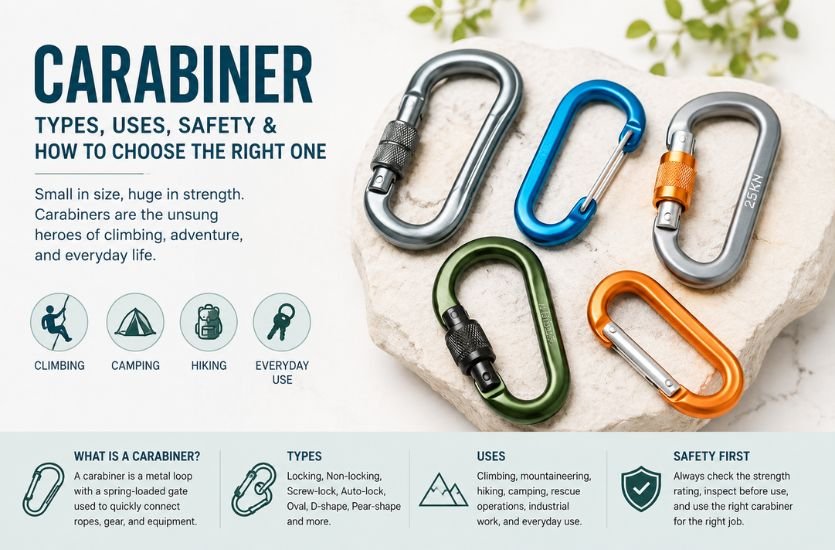

A small piece of metal can become the difference between adventure and danger when thousands of feet above the ground. The carabiner, a simple-looking loop with a spring-loaded gate, has transformed the way climbers, rescue professionals, and outdoor enthusiasts connect, secure, and protect their equipment. Although many people recognize carabiners as keychain accessories, their true purpose goes far beyond holding keys. These compact devices are carefully engineered safety tools that play a critical role in climbing, mountaineering, industrial work, and emergency rescue operations.
Also Read: Squab
From professional rock climbers depending on them during difficult ascents to hikers using them for organizing outdoor gear, carabiners have become one of the most recognizable symbols of adventure. Their lightweight design, impressive strength, and versatility have made them an essential part of modern outdoor equipment. Understanding what a carabiner is, how it works, the different types available, and how to use it safely can help beginners and experienced users make better decisions.
What Is a Carabiner?
A carabiner is a metal connector designed with a movable gate that opens and closes, allowing ropes, straps, and other equipment to be attached quickly. Most carabiners are shaped like an oval or a modified letter “D” and include a spring mechanism that automatically closes the gate after it is released.
The primary purpose of a carabiner is to create a secure connection between different pieces of equipment. In climbing, a carabiner may connect a climber’s harness to a rope system, attach ropes to anchors, or hold climbing protection devices. In rescue situations, carabiners help connect safety equipment and support complex rope systems.
Professional climbing carabiners are manufactured under strict safety standards and are tested to withstand significant forces. They are usually made from strong aluminum alloys because this material provides an excellent balance between strength and lightweight performance. Steel carabiners are also available for situations where maximum durability is more important than weight.
However, not every carabiner-looking clip is designed for climbing. Many small carabiners sold for keys, bags, and accessories are only meant for carrying lightweight items. These decorative clips should never be used for supporting body weight or safety applications.
The History of the Carabiner
The development of the carabiner is closely connected with military equipment and the evolution of climbing. The word “carabiner” comes from “carbine,” a type of firearm historically used by cavalry soldiers. Soldiers used metal hooks and clips to attach equipment, and these early designs inspired later versions of the carabiner.
During the early days of mountaineering, climbers searched for stronger and more reliable ways to manage ropes and equipment. Metal connectors based on military clips began appearing in climbing systems during the early 20th century. Over time, manufacturers improved these designs by making them lighter, stronger, and easier to operate.
As climbing technology developed, carabiners became more specialized. Different shapes, locking systems, and gate designs were introduced to meet the needs of different climbing styles. Today, modern carabiners are highly engineered products that combine advanced materials, precise manufacturing, and extensive safety testing.
The modern climbing industry relies heavily on carabiners, and they remain one of the most important inventions in outdoor safety equipment.
How Does a Carabiner Work?
A carabiner works by creating a secure connection through its frame and gate system. The main body forms a strong metal loop, while the gate provides an opening that allows ropes or equipment to pass through.
When the gate is pushed open, users can quickly attach or remove equipment. Once released, the spring mechanism closes the gate automatically. Some models include additional locking systems that prevent the gate from opening accidentally.
The strength of a carabiner depends on how it is loaded. Carabiners are strongest when force is applied along the main axis, which means the pressure runs from one end of the frame to the other. Incorrect loading, such as applying force sideways or across the gate, can greatly reduce their strength.
Because safety depends on proper use, climbers learn specific techniques for positioning and checking carabiners before every use.
Different Types of Carabiners
Carabiners come in various designs, each created for specific purposes. Choosing the right type depends on the activity, equipment requirements, and level of safety needed.
Locking Carabiners
Locking carabiners include an additional mechanism that prevents accidental opening of the gate. These are commonly used in situations where reliability is extremely important, such as belaying, rappelling, anchor systems, and rescue operations.
A screw-lock carabiner uses a threaded sleeve that manually rotates over the gate. Users must physically tighten the sleeve to secure the carabiner. These models are popular because they are simple, dependable, and easy to inspect.
Auto-locking carabiners use a mechanism that automatically locks after the gate closes. They provide faster operation and reduce the chance of forgetting to lock the gate. However, they often require more maintenance because the locking mechanism contains moving parts.
Locking carabiners are usually preferred when a connection must remain secure for long periods or when accidental opening could create serious risks.
Non-Locking Carabiners
Non-locking carabiners are lighter and faster to operate because they do not have an additional locking mechanism. They are commonly used for quickdraws, climbing protection systems, and situations where speed and efficiency are important.
These carabiners are widely used by sport climbers because they allow quick clipping while moving through a route. Although they are reliable when used correctly, they require proper positioning because the gate can potentially open if it experiences certain impacts.
Carabiner Shapes Explained
The shape of a carabiner affects its strength, handling, and purpose.
D-shaped carabiners are among the most common designs. Their shape directs most of the force toward the strongest part of the frame, making them strong while keeping weight low. They are versatile and used for many climbing applications.
Oval carabiners have a symmetrical shape that allows equipment to sit evenly inside the frame. They are especially useful when carrying multiple pieces of gear because they prevent equipment from shifting too much.
Pear-shaped carabiners provide a larger opening area, making them popular for belaying and situations where climbers need extra space for ropes and knots. Their wider design makes handling ropes easier.
HMS carabiners are a specialized pear-shaped design commonly used with Munter hitch knots and belay devices. They provide enough space for proper rope management during climbing activities.
Different Carabiner Gate Designs
The gate design affects how easily a carabiner can be used and what situations it is best suited for.
Straight-gate carabiners feature a traditional straight gate and are commonly used for clipping bolts, anchors, and gear. They provide reliable performance and simple operation.
Bent-gate carabiners have a curved gate that makes rope clipping faster. They are often found on quickdraws because the shape allows climbers to clip ropes more efficiently during challenging routes.
Wire-gate carabiners use a lightweight wire instead of a solid metal gate. They are popular because they weigh less, perform well in cold environments, and are less likely to freeze due to moisture buildup.
Materials Used in Carabiner Manufacturing
Most climbing carabiners are made from aluminum alloy because it provides excellent strength while keeping weight low. Lightweight equipment is especially important for climbers who carry large amounts of gear during long routes.
Steel carabiners are heavier but offer exceptional durability. They are commonly used in industrial applications, construction, rescue work, and situations where equipment receives heavy wear.
Manufacturers carefully design carabiners to balance weight, strength, durability, and usability. Modern production techniques allow companies to create lightweight models that still meet demanding safety requirements.
Common Uses of Carabiners
Although climbing is the activity most associated with carabiners, these devices are used in many different fields.
Rock climbing remains the primary use for professional carabiners. Climbers use them to connect ropes, harnesses, anchors, quickdraws, and protection equipment. A reliable carabiner system allows climbers to move safely while managing complex rope arrangements.
Mountaineers use specialized carabiners during alpine adventures, ice climbing, and high-altitude expeditions. These environments often require equipment that performs in extreme weather conditions.
Hikers and campers frequently use small accessory carabiners to organize backpacks, attach water bottles, secure equipment, and keep important items easily accessible. These lightweight clips are convenient for everyday outdoor activities, although they are not designed for climbing.
Emergency rescue teams and firefighters use heavy-duty carabiners as part of their safety systems. In these situations, strength and reliability are essential because equipment may be used in difficult and dangerous environments.
Carabiners are also popular in everyday carry communities. Many people attach small clips to keys, flashlights, tools, and bags because of their convenience and portability.
Understanding Carabiner Strength Ratings
One of the most important features of a climbing carabiner is its strength rating. Strength is usually measured in kilonewtons (kN), a unit that describes force.
Carabiners typically display strength ratings for different situations, including the major axis, minor axis, and open gate strength. The major axis rating represents the strongest position, while the open gate rating is usually much lower.
These ratings help users understand how the carabiner performs under different forces. A properly used climbing carabiner can handle significant loads, but incorrect positioning can reduce its effectiveness.
Carabiner Safety Tips
Using a carabiner correctly is essential for safety. Before every use, climbers should inspect their equipment for damage, cracks, corrosion, or problems with the gate mechanism.
The gate should open and close smoothly without sticking. Locking mechanisms should function properly and remain secure when engaged.
Users should avoid dropping carabiners from significant heights because strong impacts can create hidden damage. Equipment exposed to extreme conditions or heavy use should be replaced according to manufacturer recommendations.
It is also important to use carabiners only for their intended purpose. A small accessory clip may look similar to a climbing carabiner, but it does not have the strength or testing required for safety applications.
Carabiner vs Clip: Understanding the Difference
The terms “carabiner” and “clip” are often used interchangeably, but they are not always the same. A climbing carabiner is a certified piece of safety equipment designed to support loads and withstand significant forces.
A simple clip used for keys, bags, or accessories is designed only for convenience. These products may look similar but lack the engineering, materials, and testing required for climbing.
Understanding this difference is important because using the wrong type of clip in a safety situation can create serious risks.
How to Choose the Right Carabiner
Selecting the right carabiner depends on how it will be used. Climbers should consider factors such as activity type, weight, locking system, shape, and certification.
For general climbing, many users choose lightweight aluminum carabiners because they provide a good combination of strength and portability. For industrial or rescue applications, heavier steel models may be more appropriate.
Beginners should focus on learning proper usage techniques rather than simply choosing the lightest or cheapest option. A quality carabiner from a trusted manufacturer provides better reliability and confidence.
Conclusion
The carabiner may appear simple, but its role in outdoor adventure and safety is incredibly important. From climbing steep mountain walls to supporting rescue operations, this small metal connector has become one of the most valuable tools in the world of outdoor equipment.
Understanding different types of carabiners, their designs, materials, and safety requirements helps users make smarter choices and use them responsibly. Whether someone is a professional climber, a weekend hiker, or simply interested in outdoor gear, learning about carabiners reveals how thoughtful engineering can turn a small device into a powerful safety tool.