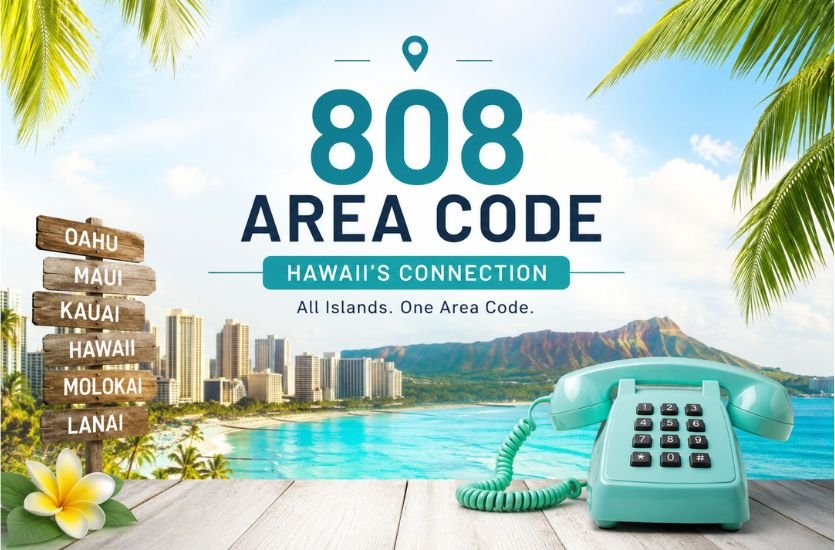

A phone number can reveal more than just a way to reach someone—it can tell a story about geography, culture, and even history. Few area codes in the United States are as recognizable as the 808 area code, a number that has become closely associated with the tropical beauty and unique identity of Hawaii. Whether you’ve received a call from an 808 number, plan to travel to the islands, or want a local Hawaiian phone number for your business, understanding the significance of this area code can be surprisingly useful.
Unlike most U.S. states, which use multiple area codes to serve growing populations, Hawaii has continued to rely on a single area code for decades. This makes 808 one of the most distinctive and memorable telephone area codes in the country. It covers every major island, every city, and virtually every residential and business telephone number throughout the state.
This comprehensive guide explores everything you need to know about the 808 area code, including its location, history, cities it serves, time zone, dialing rules, business advantages, common scams, and answers to frequently asked questions.
Also Read: Oxford Comma Meme: Meaning, Funny Examples, and Why It Matters
What Is the 808 Area Code?
The 808 area code is the sole telephone area code assigned to the entire state of Hawaii under the North American Numbering Plan (NANP). It serves millions of residents, businesses, government agencies, educational institutions, and visitors across the Hawaiian Islands.
An area code is the first three digits of a ten-digit telephone number and identifies the geographic region associated with that number. While many U.S. states require multiple area codes because of population growth and increasing demand for phone numbers, Hawaii has successfully maintained just one statewide area code.
Every landline, mobile phone, business telephone, and most Voice over Internet Protocol (VoIP) numbers registered in Hawaii begin with the digits 808.
Because of its statewide coverage, the 808 area code has become more than a telecommunications identifier—it has become part of Hawaii’s cultural identity. Residents often recognize it as a symbol of local pride, and businesses frequently use it in branding to emphasize their Hawaiian roots.
Where Is the 808 Area Code Located?
The 808 area code serves the entire state of Hawaii, making it unique among U.S. area codes. Rather than being limited to one city or county, it extends across every inhabited Hawaiian island.
This includes Oahu, Maui, Kauai, Hawaii (commonly called the Big Island), Molokai, Lanai, Niihau, and Kahoolawe. It also serves Wake Island, a remote U.S. territory located in the western Pacific Ocean for telecommunications purposes.
The largest concentration of telephone numbers can be found on Oahu, where Honolulu, the state’s capital and largest city, is located. However, every community throughout Hawaii shares the same area code regardless of population size or location.
For visitors, seeing an 808 phone number almost always indicates that the caller or business is associated with Hawaii, although modern technologies such as VoIP and number portability mean that users can sometimes keep their 808 numbers even after relocating elsewhere.
Major Cities Covered by the 808 Area Code
One of the most interesting aspects of the 808 area code is that it covers every city and town throughout Hawaii. Since there are no additional area codes within the state, every major urban area uses the same dialing prefix.
Honolulu is by far the largest city served by the 808 area code. As Hawaii’s economic, political, and cultural center, Honolulu is home to hundreds of thousands of residents and countless businesses.
Hilo, located on the eastern side of the Big Island, is another major city using the 808 area code. Known for its lush rainforests, waterfalls, and proximity to Hawaii Volcanoes National Park, Hilo is one of the state’s most important regional hubs.
Kahului serves as Maui’s commercial center and is home to one of Hawaii’s busiest airports. Other important communities include Kailua, Kaneohe, Pearl City, Waipahu, Kapolei, Wailuku, Kihei, Lahaina, Mililani, and Ewa Beach.
Smaller towns and rural communities throughout every island also share the same area code, making 808 a truly statewide identifier.
The History Behind the 808 Area Code
The history of the 808 area code dates back to the early years of modern telephone service in the United States. It was introduced as part of the North American Numbering Plan, a system developed to simplify long-distance telephone calls across North America.
Interestingly, the 808 area code was assigned before Hawaii officially became the 50th state of the United States in 1959. At the time, Hawaii was still a U.S. territory, but its unique geographic location required a dedicated telephone numbering system.
Since its introduction, the 808 area code has remained unchanged. Unlike many mainland states that have undergone area code splits or overlays due to rapid population growth and increased demand for telephone numbers, Hawaii has successfully continued using just one area code.
This consistency has made 808 one of the oldest continuously operating area codes in the United States. It also reflects Hawaii’s relatively stable population and careful management of telephone numbering resources.
Over the decades, the area code has become widely recognized around the world, often appearing on souvenirs, clothing, local businesses, and even social media as a symbol of Hawaiian identity.
Why Does Hawaii Have Only One Area Code?
Many people are surprised to learn that Hawaii has never needed a second area code. Several factors explain why the state has been able to continue using only 808.
First, Hawaii’s population is significantly smaller than that of many mainland states. Even though tourism brings millions of visitors every year, permanent residents number only around one and a half million.
Second, the geographic isolation of Hawaii naturally limits the concentration of telephone numbers compared to densely populated metropolitan regions on the mainland.
Third, advancements in telecommunications management have allowed phone number administrators to allocate available numbers more efficiently. Improved conservation measures have delayed the need for additional area codes.
Finally, Hawaii’s unique geography makes a single statewide area code practical and convenient for residents. Unlike large continental states with multiple metropolitan regions, Hawaii’s islands function together under one telecommunications identity.
This unified system simplifies dialing and reinforces the state’s distinctive identity.
Time Zone of the 808 Area Code
The entire 808 area code operates on Hawaii-Aleutian Standard Time (HST), which is UTC−10:00. One feature that makes Hawaii unique is that it does not observe Daylight Saving Time. While most U.S. states move their clocks forward in spring and back in autumn, Hawaii keeps the same time throughout the year.
For businesses communicating with customers on the U.S. mainland, this time difference is important. During much of the year, Hawaii is several hours behind states such as California, Texas, New York, and Florida. Companies that provide customer support or schedule virtual meetings often account for this difference to ensure smooth communication.
Travelers also benefit from understanding Hawaii’s time zone before arriving. Knowing the local time can help avoid missed hotel check-ins, tour departures, business meetings, or flights.
How to Dial an 808 Phone Number
Calling an 808 phone number is straightforward, whether you are within Hawaii or elsewhere in the United States.
For domestic calls, you simply dial the full ten-digit number, including the 808 area code. Since the implementation of mandatory ten-digit dialing, even local calls require the area code.
If you are calling from outside the United States, you first dial your country’s international access code, followed by the U.S. country code (+1), then the 808 area code and the seven-digit phone number.
For example, an international caller would use the format:
+1 808 XXX XXXX
Using the complete dialing format helps ensure calls are routed correctly through international telephone networks.
Why Ten-Digit Dialing Became Mandatory
For many years, Hawaii residents could make local calls by dialing only the seven-digit phone number. However, this changed when the nationwide 988 Suicide & Crisis Lifeline was introduced.
Because some Hawaii telephone exchanges used 988 as their first three digits, seven-digit dialing created conflicts with the new emergency service. To eliminate confusion, mandatory ten-digit dialing was implemented across Hawaii.
Since October 2021, every local call requires dialing:
808 + seven-digit phone number
Although the change required some adjustment, it improved consistency and ensured that emergency mental health services remained easily accessible nationwide.
Is the 808 Area Code Only for Cell Phones?
A common misconception is that the 808 area code belongs exclusively to mobile phones. In reality, the area code covers every major category of telephone service.
Residential landlines, business phone systems, mobile phones, government offices, educational institutions, healthcare providers, and internet-based VoIP services all use 808 numbers.
Today, many businesses choose cloud-based phone systems that allow employees to work remotely while keeping an authentic Hawaiian telephone number. Likewise, residents can transfer their existing 808 numbers when changing mobile carriers without losing their familiar contact information.
Because the area code is shared across multiple telephone technologies, it does not indicate whether the caller is using a mobile phone or a landline.
Can You Get an 808 Phone Number?
Yes. Obtaining an 808 phone number is possible even if you do not currently live in Hawaii.
Many telecommunications providers offer virtual Hawaii numbers through cloud-based business phone services. These numbers enable companies located anywhere in the world to establish a local Hawaiian presence while forwarding incoming calls to another office or mobile device.
Entrepreneurs expanding into Hawaii often use virtual 808 numbers to increase customer confidence and improve local accessibility. Since customers generally prefer calling local numbers rather than long-distance ones, having an 808 phone number can make a business appear more established within the Hawaiian market.
Individuals relocating to Hawaii may also request an 808 number from their wireless carrier when activating new service.
Business Benefits of an 808 Area Code
For businesses targeting customers in Hawaii, an 808 phone number offers several practical advantages beyond simple communication.
A local number immediately creates familiarity with residents who recognize 808 as Hawaii’s statewide area code. Customers are often more comfortable answering calls from numbers that appear local rather than unfamiliar out-of-state area codes.
Companies serving tourism, hospitality, vacation rentals, real estate, legal services, healthcare, or local retail markets frequently use 808 numbers to strengthen customer trust.
Virtual phone technology has made this easier than ever. Business owners can maintain an 808 phone number while operating from another state or even another country. Incoming calls can be forwarded to smartphones, office phones, or customer support centers without revealing the company’s physical location.
Additionally, many cloud phone providers include features such as voicemail transcription, call recording, automated attendants, call analytics, and business texting, making an 808 number valuable for organizations of all sizes.
Is Every 808 Caller Actually in Hawaii?
Not necessarily.
Modern telecommunications technology allows phone numbers to be transferred between carriers and used through internet-based phone systems. Someone may have originally received an 808 number while living in Hawaii and later moved elsewhere without changing it.
Similarly, businesses can purchase virtual 808 numbers to establish a local Hawaiian presence despite operating from another state.
Another factor is caller ID spoofing. Fraudsters can manipulate caller ID information so that incoming calls appear to originate from an 808 number even when the caller is located somewhere entirely different.
Therefore, while many 808 numbers genuinely belong to Hawaii residents and businesses, the area code alone should not be considered proof of the caller’s physical location.
Common 808 Area Code Scams
Like every other U.S. area code, 808 has occasionally been exploited by scammers using caller ID spoofing technology. The area code itself is completely legitimate, but criminals may disguise their real numbers to increase the likelihood that someone answers the call.
One common scam involves individuals pretending to represent government agencies. Victims may receive threatening calls claiming unpaid taxes, legal problems, or immigration issues that require immediate payment. Legitimate government organizations rarely demand payment over unsolicited phone calls.
Another frequent scheme involves banks or financial institutions. Callers claim suspicious activity has been detected on an account and ask victims to verify passwords, PINs, or one-time security codes. Genuine banks typically advise customers never to share confidential login credentials over the phone.
Delivery scams have also become increasingly common. Callers pretend to represent shipping companies, informing recipients that a package cannot be delivered unless additional fees or personal information are provided. These calls often target online shoppers expecting legitimate deliveries.
Technical support scams continue to affect many consumers as well. Fraudsters claim to be from well-known technology companies, warning that a computer or smartphone has been infected with malware. They then attempt to gain remote access to the victim’s device or request payment for unnecessary repairs.
Lottery and prize scams remain another popular tactic. Victims are informed they have won a large cash prize or vacation but must first pay taxes or processing fees before receiving their reward. Legitimate sweepstakes do not require winners to pay upfront charges.
Whenever you receive an unexpected call from an 808 number requesting money, personal information, passwords, or immediate action, it is wise to remain cautious. Hanging up and contacting the organization directly using its official phone number is often the safest approach.
Interesting Facts About the 808 Area Code
The 808 area code is much more than a telephone prefix—it has become a recognizable symbol of Hawaii itself. Over the years, the number has appeared on clothing, stickers, business logos, license plate frames, and souvenirs sold across the islands. Many local companies proudly include “808” in their brand names because residents immediately associate it with Hawaiian culture and community.
One of the most fascinating facts about the 808 area code is that it has never been split or overlaid with another area code. In many U.S. states, growing populations have forced telecommunications authorities to introduce additional area codes. Cities such as Los Angeles, New York, and Dallas now use multiple overlapping area codes due to increased demand for phone numbers. Hawaii, however, has maintained a single statewide code for decades, making it one of the few places in the country where every resident shares the same area code.
The number “808” has also gained popularity outside telecommunications. It is frequently used in music, fashion, social media usernames, and local branding as a shorthand reference to Hawaii. While many people also recognize “808” because of the famous Roland TR-808 drum machine, the musical instrument and Hawaii’s area code are completely unrelated. Their shared number is simply a coincidence.
Because Hawaii attracts millions of visitors every year, the 808 area code has become familiar to travelers from around the world. Vacation rental companies, hotels, tour operators, restaurants, and transportation services all commonly use 808 numbers, making the area code one of the most recognizable in American tourism.
The Future of the 808 Area Code
As technology continues to evolve, many people wonder whether Hawaii will eventually require another area code. At present, telecommunications experts believe the existing numbering resources remain sufficient for the state’s needs.
Several factors contribute to this stability. Hawaii’s permanent population has grown steadily but not at the explosive rate seen in many mainland metropolitan areas. Number conservation practices have also become much more efficient, allowing service providers to allocate available numbers without unnecessary waste.
Modern communication methods have further reduced pressure on traditional telephone numbering. Many individuals now rely on internet messaging platforms, video conferencing applications, and cloud-based communication services in addition to conventional phone calls. Although these technologies still require phone numbers in many cases, improved number management has helped extend the lifespan of existing numbering resources.
Unless there is a dramatic increase in population or demand for new telephone numbers, Hawaii is expected to continue using the 808 area code for many years. This means residents and businesses can likely enjoy the simplicity of a single statewide area code well into the future.
How the 808 Area Code Supports Hawaii’s Economy
The 808 area code plays an important role in Hawaii’s economy by supporting communication across industries that are essential to the state. Tourism, one of Hawaii’s largest economic sectors, depends heavily on reliable telephone services. Hotels, airlines, travel agencies, restaurants, activity providers, and transportation companies all use 808 numbers to assist visitors before, during, and after their trips.
Small businesses also benefit from the area code’s strong local identity. Whether it’s a family-owned surf shop in Waikiki, a coffee farm on the Big Island, or a boutique hotel on Maui, displaying an 808 phone number reassures customers that they are dealing with a business connected to Hawaii.
Government agencies, schools, healthcare providers, emergency services, and nonprofit organizations likewise rely on the statewide area code to maintain consistent communication across the islands. Because every island shares the same area code, residents can easily recognize official local numbers.
Tips for Handling Calls from an 808 Number
Receiving a call from an 808 number is usually nothing to worry about, especially if you have friends, relatives, customers, or business contacts in Hawaii. However, as with any phone call, it is wise to remain cautious when the caller is unfamiliar.
If you receive an unexpected call requesting sensitive personal information, banking details, passwords, or immediate payment, avoid providing any information until you have verified the caller’s identity. Caller ID can be manipulated, so the displayed area code should never be the sole reason to trust a caller.
If you miss a call from an unknown 808 number, consider checking whether the number belongs to a legitimate business before returning the call. Many companies list their official contact numbers on their websites, making verification relatively easy.
Businesses should also ensure their outbound calls display accurate caller identification. Customers are more likely to answer calls from recognizable local numbers than from blocked or unidentified callers.
Frequently Asked Questions
Is the 808 area code only used in Hawaii?
Yes. The 808 area code is assigned to the entire state of Hawaii. It also serves Wake Island for telecommunications purposes, but within the United States, it is uniquely associated with Hawaii.
Which cities use the 808 area code?
Every city and town in Hawaii uses the 808 area code. This includes Honolulu, Hilo, Kahului, Kailua, Kaneohe, Pearl City, Kapolei, Waipahu, Wailuku, Kihei, Lahaina, Mililani, and many smaller communities across all Hawaiian islands.
Does Hawaii have more than one area code?
No. Hawaii currently operates with a single statewide area code, making it one of the few U.S. states that has never required an additional area code.
Can I keep my 808 number if I move?
In many cases, yes. Thanks to number portability, mobile phone users can often retain their existing 808 number even after moving to another state, provided their carrier supports the transfer.
Is every 808 call coming from Hawaii?
Not always. Although the number belongs to Hawaii, virtual phone systems, number portability, and caller ID spoofing mean that some callers may actually be located elsewhere.
Are 808 numbers safe?
Most 808 phone numbers belong to legitimate residents and businesses in Hawaii. However, scammers can spoof any area code, including 808. Always verify unexpected callers before sharing personal or financial information.
How do I get an 808 phone number?
You can obtain an 808 number through many mobile carriers if you live in Hawaii or through virtual phone service providers that offer Hawaiian business numbers.
Final Thoughts
The 808 area code is more than just the first three digits of a phone number—it represents the entire state of Hawaii and reflects the islands’ unique identity. As the only area code serving every Hawaiian island, it has become a recognizable symbol for residents, businesses, and visitors alike. Its long history, statewide coverage, and continued use without splits or overlays make it one of the most distinctive area codes in the United States.
Whether you’re trying to identify an incoming call, planning a move to Hawaii, starting a business that serves local customers, or simply curious about the state’s telecommunications system, understanding the 808 area code provides valuable insight into how Hawaii stays connected. From bustling Honolulu to the quiet communities scattered across the islands, every call beginning with 808 carries a connection to one of the world’s most unique and beautiful destinations.
As technology continues to evolve, the 808 area code is expected to remain an enduring part of Hawaii’s communication network. Its simplicity, statewide recognition, and cultural significance ensure that it will continue to symbolize the Aloha State for years to come.