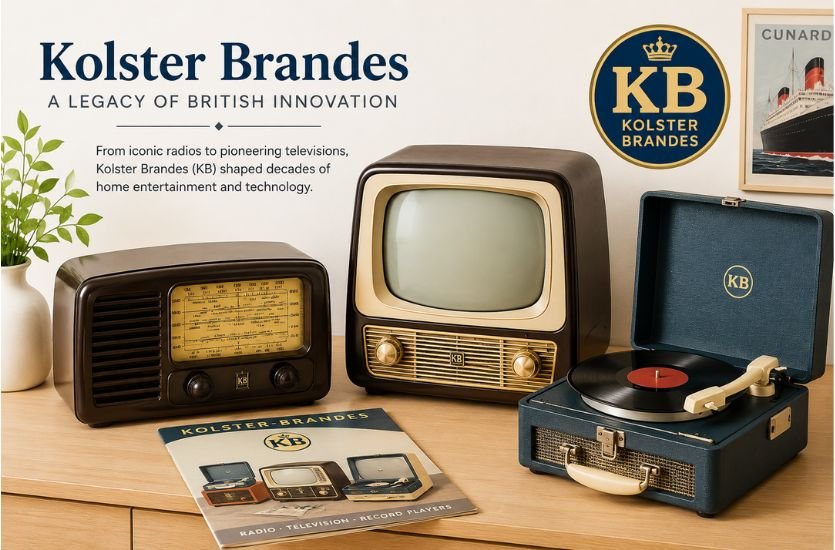
Kolster Brandes: The Rise, Innovation, and Lasting Legacy of a British Electronics Pioneer

Introduction
Every generation has its iconic technology brands that define the way people experience entertainment and communication. Long before smart televisions, wireless speakers, and digital streaming became everyday conveniences, families gathered around beautifully crafted radios and television sets that represented the very latest in home technology. Among the companies responsible for shaping that golden era was Kolster Brandes, more commonly known by its famous initials, KB.
For much of the twentieth century, Kolster Brandes stood as one of Britain’s most respected manufacturers of consumer electronics. From elegant valve radios and pioneering television receivers to record players, tape recorders, and hi-fi systems, the company earned a reputation for combining quality engineering with stylish design. Millions of households trusted KB products, making the brand a familiar name throughout the United Kingdom and beyond.
Although the Kolster Brandes name eventually disappeared after becoming part of ITT, its influence remains visible today. Collectors actively restore vintage KB radios, museums preserve its historic products, and enthusiasts continue celebrating the company’s remarkable contribution to British electronics. Understanding the history of Kolster Brandes offers a fascinating look into the rapid technological evolution of the twentieth century and the brands that helped shape modern home entertainment.
The Origins of Kolster Brandes
The roots of Kolster Brandes stretch back to the early days of radio communication. Before becoming a household name in Britain, the story began with the Brandes Company, established in Toronto, Canada, in 1908. During this period, radio technology was still in its infancy, and demand for quality communication equipment was steadily increasing.
Brandes initially focused on manufacturing headphones and radio accessories, products that were essential for both amateur radio enthusiasts and commercial users. As wireless communication expanded across North America and Europe, Brandes developed a strong reputation for producing reliable equipment.
The company’s success attracted the attention of larger telecommunications organizations. In 1922, Brandes became part of the American Telephone and Telegraph Company (AT&T), providing greater financial support and access to expanding international markets. This new ownership allowed the business to broaden its manufacturing capabilities while preparing for future growth in consumer electronics.
Expansion into the British Market
Recognizing the growing popularity of radio broadcasting throughout the United Kingdom, Brandes established a British subsidiary known as Brandes Ltd. in Slough, England, during 1924. The British operation focused on producing headphones, loudspeakers, and radio components for an increasingly enthusiastic consumer market.
Radio ownership was rising rapidly across Britain during the 1920s. Families viewed wireless sets as revolutionary devices capable of bringing news, music, educational programs, and entertainment directly into their homes. Manufacturers competed fiercely to produce reliable and affordable products, creating an ideal environment for Brandes to expand its operations.
The company’s commitment to manufacturing quality products helped establish a strong reputation among British consumers. This early success laid the foundation for what would eventually become one of Britain’s best-known electronics manufacturers.
The Birth of Kolster Brandes
A significant turning point arrived toward the end of the 1920s when Brandes became associated with the Kolster Radio Corporation in the United States. The merger combined the strengths of both organizations and resulted in the formation of Kolster-Brandes Ltd., commonly abbreviated as KB.
The new identity reflected a broader vision than simply producing radio accessories. Instead, Kolster Brandes positioned itself as a comprehensive electronics manufacturer capable of designing complete radio receivers and eventually expanding into numerous other consumer technologies.
The initials “KB” soon became widely recognized throughout Britain. Consumers associated the brand with dependable engineering, attractive cabinet designs, and modern technology. This reputation would continue growing over the following decades as the company introduced increasingly sophisticated products.
Moving to Foots Cray and Rapid Growth
As demand for KB products increased, the company’s original facilities became insufficient for large-scale manufacturing. Kolster Brandes relocated its primary operations to a much larger factory at Foots Cray in Sidcup, Kent.
The new manufacturing complex allowed the company to significantly increase production capacity while introducing more efficient manufacturing techniques. Thousands of radios and other electronic products were assembled within the factory, creating employment opportunities and supporting Britain’s growing electronics industry.
The Foots Cray facility became closely associated with the KB brand for many years. It served as the center for research, engineering, production, and product development during some of the company’s most successful decades.
A Marketing Success That Built the KB Name
One of Kolster Brandes’ earliest commercial successes came through an innovative marketing campaign that dramatically expanded public awareness of the company.
In 1930, the tobacco company Godfrey Phillips launched a promotion allowing customers to redeem cigarette coupons for specially produced KB “Masterpiece” two-valve radios. Approximately 40,000 radios were manufactured for this campaign, making it one of the largest promotional electronics projects of its time.
The promotion introduced countless households to the KB brand. Many families who might not otherwise have purchased a radio suddenly owned a reliable receiver manufactured by Kolster Brandes. The campaign significantly increased brand recognition and helped establish KB as a trusted name throughout Britain.
Radio Innovation and Product Development
Radio remained the heart of Kolster Brandes’ business for many years. Throughout the 1930s and 1940s, the company introduced an impressive range of receivers designed to meet different budgets and consumer needs.
Early valve radios became especially popular because of their dependable performance and attractive appearance. Many featured polished wooden cabinets, while others used Bakelite, a durable plastic material that allowed designers to create stylish, modern shapes.
KB engineers focused not only on technical performance but also on ease of use. Clear tuning scales, improved speaker quality, and dependable circuitry made the company’s radios suitable for everyday family life.
As broadcasting expanded, listeners relied on their KB radios for national news, sporting events, music concerts, educational programming, and wartime announcements. These products became central to daily life, transforming the way information reached ordinary households.
Surviving Wartime Challenges
Like many British manufacturers, Kolster Brandes faced enormous challenges during the Second World War. Civilian production slowed as industrial resources shifted toward supporting the national war effort.
The company’s engineering expertise proved valuable during this period, contributing to communications technology and other equipment needed for military applications. Although consumer electronics production was reduced, the knowledge gained during wartime engineering would later benefit post-war product development.
Following the war, demand for household electronics surged as families sought modern conveniences and entertainment. Kolster Brandes was well positioned to meet this demand thanks to its experienced workforce and established manufacturing facilities.
Entering the Television Age
The years following World War II marked the beginning of television’s rapid expansion across Britain. Kolster Brandes quickly recognized the enormous potential of this new medium and invested heavily in television receiver development.
KB televisions earned praise for their picture quality, reliable engineering, and elegant cabinet designs. Initially producing black-and-white television sets, the company helped bring televised entertainment into British homes at a time when television ownership represented modern living.
Families gathered around KB television sets to watch news broadcasts, sporting events, dramas, variety shows, and royal ceremonies. Television quickly became the centerpiece of household entertainment, and Kolster Brandes played an important role in making this technology accessible to ordinary consumers.
Many of the company’s television models carried names inspired by famous Cunard ocean liners, reflecting another important partnership that contributed to the KB brand’s prestige.
The Cunard Connection
One of the more distinctive chapters in Kolster Brandes’ history involved its relationship with Cunard, one of Britain’s most famous shipping companies.
KB supplied communication equipment and television receivers for Cunard vessels, including the legendary RMS Queen Mary. This partnership demonstrated the company’s ability to produce equipment capable of meeting demanding commercial standards rather than serving only domestic customers.
The association with Cunard also influenced product marketing. Several KB television models borrowed names associated with Cunard ships, reinforcing an image of quality, reliability, and British engineering excellence.
Expanding Beyond Radios and Televisions
As consumer technology continued evolving throughout the 1950s and 1960s, Kolster Brandes recognized that households wanted more than just radios and televisions. The growing popularity of recorded music created new opportunities, and the company responded by expanding its product range into record players, tape recorders, amplifiers, and hi-fi systems.
KB record players became popular because they combined attractive cabinet designs with dependable mechanical engineering. Families could enjoy their favorite vinyl records at home without requiring complicated equipment. Whether listening to classical music, jazz, rock and roll, or spoken-word recordings, consumers appreciated the convenience and quality that KB products delivered.
The company introduced several memorable record player series, including the Playtime, Gaytime, Dancetime, Tunetime, and Rhythm models. These products reflected changing musical tastes and the growing importance of home entertainment. Many of these units were designed to complement existing radios or televisions, allowing customers to build complete entertainment systems within their homes.
Tape recorders also became an important part of the company’s portfolio. During an era when recording personal audio at home was still considered innovative, KB tape recorders enabled users to preserve family memories, record music broadcasts, and create personal collections of audio recordings. These machines demonstrated the company’s ability to keep pace with rapidly changing consumer demands.
The expansion into hi-fi equipment represented another milestone. Stereo sound was transforming the listening experience, and Kolster Brandes introduced amplifiers and audio systems that delivered richer, clearer sound than earlier generations of equipment. Products such as the PHC 20 and PHA 30 stereo systems reflected the company’s commitment to combining advanced engineering with practical home use.
Design Philosophy and Manufacturing Quality
One reason behind Kolster Brandes’ lasting popularity was its dedication to product quality. Rather than focusing solely on affordability, the company invested considerable effort in creating products that balanced performance, durability, and visual appeal.
Early KB radios often featured polished wooden cabinets that blended naturally with traditional British furniture. As new materials became available, Bakelite emerged as a popular choice. This durable plastic allowed designers to create elegant curves and modern shapes that distinguished KB products from many competitors. Today, these Bakelite radios remain highly desirable among collectors because of their timeless appearance and craftsmanship.
The company’s television cabinets reflected similar attention to detail. Instead of appearing purely functional, many models were designed to complement the décor of living rooms and family spaces. Attractive finishes, carefully arranged control panels, and thoughtfully proportioned cabinets helped transform electronic appliances into pieces of furniture.
Internally, KB engineers emphasized dependable circuitry and carefully assembled components. Valve technology required precise engineering, and the company’s reputation for reliability encouraged repeat purchases from satisfied customers. Even decades later, many surviving KB products continue functioning after professional restoration, highlighting the quality of their original construction.
Becoming Part of ITT
A major development in the company’s history occurred in 1938 when Kolster Brandes became part of Standard Telephones and Cables (STC), which itself belonged to the international telecommunications giant International Telephone and Telegraph, better known as ITT.
Joining the ITT organization provided Kolster Brandes with greater financial stability and access to extensive research resources. As electronics became increasingly sophisticated during the mid-twentieth century, belonging to a multinational corporation allowed KB to remain competitive in an industry experiencing constant technological change.
The relationship also encouraged closer cooperation between consumer electronics and telecommunications engineering. Knowledge developed within ITT’s global network contributed to product improvements, manufacturing methods, and technological innovation across the company’s product lines.
Although the KB identity remained strong for many years after the acquisition, the influence of ITT gradually became more visible through branding and product development.
Competition in a Changing Electronics Industry
The post-war decades brought remarkable advances in consumer electronics, but they also introduced increasingly intense competition. British manufacturers found themselves competing not only with domestic rivals but also with rapidly growing international companies from Europe, Japan, and the United States.
The transition from valve technology to transistors fundamentally changed the electronics industry. Transistor-based equipment offered smaller sizes, improved energy efficiency, greater reliability, and lower manufacturing costs. Companies that adapted quickly gained significant competitive advantages.
Kolster Brandes embraced many of these technological developments, producing transistor radios and more compact consumer electronics. However, the pace of innovation accelerated throughout the 1960s and early 1970s, making it increasingly difficult for traditional manufacturers to maintain their market positions.
Consumers also expected more affordable products while demanding greater functionality. Meeting these expectations required substantial investment in research, manufacturing automation, and international supply chains, areas where multinational corporations often held significant advantages.
Acquisitions and Brand Expansion
Rather than limiting itself to organic growth, Kolster Brandes expanded by acquiring several respected British electronics brands. Among these were Ace, Regentone, Argosy, and RGD, each of which had established reputations within different segments of the consumer electronics market.
These acquisitions strengthened the company’s manufacturing capabilities while expanding its product portfolio and customer base. Integrating multiple brands also allowed Kolster Brandes to benefit from additional engineering expertise and broader distribution networks.
During this period, KB occupied an influential position within Britain’s consumer electronics industry. Its diverse product range enabled the company to serve customers seeking everything from entry-level radios to sophisticated home entertainment systems.
The Gradual Disappearance of the KB Name
Despite decades of success, the Kolster Brandes brand gradually disappeared during the early 1970s. As ITT strengthened its global identity, products increasingly carried the ITT name rather than the familiar KB logo.
For longtime customers, the transition marked the end of an era. The KB initials had become closely associated with British engineering and home entertainment for more than forty years. Although many of the products continued under ITT branding, the distinctive Kolster Brandes identity slowly faded from shop shelves.
By approximately 1974, the KB brand had effectively been discontinued, bringing an end to one of Britain’s most recognizable electronics manufacturers. Nevertheless, the technology, manufacturing expertise, and engineering achievements developed under the Kolster Brandes name continued influencing later generations of consumer electronics.
Why Collectors Continue to Value Kolster Brandes
Interest in vintage electronics has grown considerably over recent decades, and Kolster Brandes products remain among the most sought-after examples of British consumer technology. Collectors appreciate these devices for reasons extending far beyond nostalgia.
Many enthusiasts admire the craftsmanship evident in early KB radios. The combination of polished wood, elegant Bakelite cabinets, precision tuning mechanisms, and glowing valve components creates a unique aesthetic that modern electronics rarely replicate. Restoring these radios allows collectors to preserve an important chapter of industrial design history.
Television receivers also attract attention because they represent significant milestones in broadcasting history. Early KB televisions remind enthusiasts of the period when television first transformed family life, bringing live events and entertainment directly into homes across Britain.
Museums dedicated to communications, broadcasting, and industrial history frequently include Kolster Brandes products within their collections. These displays help visitors understand how consumer electronics evolved throughout the twentieth century and how companies like KB contributed to technological progress.
Vintage record players, amplifiers, and tape recorders remain popular among audio enthusiasts who appreciate analog sound reproduction and classic engineering. Carefully restored equipment continues functioning decades after manufacture, demonstrating the durability that originally helped establish the company’s reputation.
The Lasting Legacy of Kolster Brandes
Although the Kolster Brandes name disappeared many years ago, its influence continues to be recognized within the history of British electronics. The company helped introduce affordable radios to ordinary households, supported the expansion of television ownership, embraced changing audio technologies, and demonstrated how thoughtful engineering could improve everyday life.
Its products documented the remarkable journey from valve-powered radios to sophisticated home entertainment systems during one of the fastest periods of technological advancement in modern history. Each generation of KB equipment reflected changing consumer expectations while illustrating the company’s willingness to innovate.
Today, collectors, historians, and restoration specialists continue preserving Kolster Brandes products not simply because they are old but because they represent a period when engineering excellence, attractive design, and manufacturing quality were central to consumer electronics. These surviving radios, televisions, and audio systems remain tangible reminders of a company that played a significant role in shaping Britain’s technological landscape.
Conclusion
Kolster Brandes occupies an important place in the history of British consumer electronics. From its origins in the early twentieth century to its emergence as one of Britain’s leading manufacturers of radios, televisions, record players, and hi-fi equipment, the company consistently demonstrated a commitment to innovation, quality, and reliability. Its products became trusted companions in millions of homes, connecting families with news, music, education, and entertainment during a period of extraordinary technological change.
Although the KB brand eventually gave way to ITT, its legacy continues through preserved collections, restored vintage electronics, and the admiration of enthusiasts who recognize the company’s contribution to modern home entertainment. Every surviving Kolster Brandes radio or television tells the story of an era when craftsmanship and engineering excellence defined the consumer electronics industry. Decades after the final KB products left the factory, the brand remains a respected symbol of Britain’s rich technological heritage and an enduring reminder of how innovation can shape everyday life.