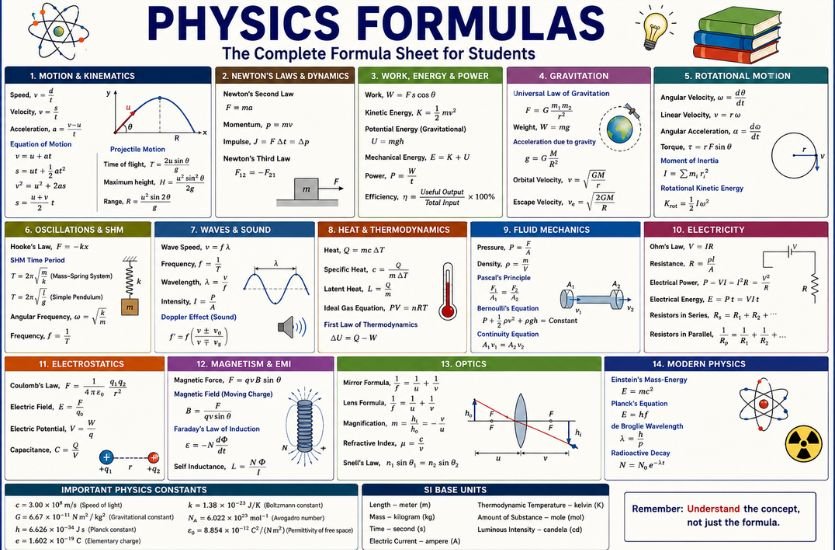
Physics Formulas: Complete List of All Physics Equations, SI Units & Formula Sheet (2026 Guide)

Every movement in the universe, from a falling apple to the orbit of distant planets, can be explained through the language of physics formulas. These equations are more than mathematical expressions—they represent the fundamental laws that govern nature. Whether you’re solving classroom problems, preparing for competitive exams like JEE, NEET, SAT Physics, AP Physics, GCSE, or simply trying to understand how the physical world works, mastering physics formulas is one of the most valuable skills you can develop.
Also Read: Quantumrun Explained: Features, Benefits, Pricing, and How AI-Powered Foresight Works
Physics formulas simplify complex scientific concepts into relationships between measurable quantities. Instead of memorizing isolated facts, students can use equations to predict outcomes, solve numerical problems, and understand the principles behind motion, electricity, heat, light, and modern physics. This comprehensive guide covers all the important physics formulas, explains where they are used, discusses SI units and physics constants, and provides practical advice for learning and remembering them effectively.
What Are Physics Formulas?
Physics formulas are mathematical equations that describe the relationships between physical quantities such as force, mass, velocity, energy, pressure, temperature, and electric current. Every formula is based on experimental observations and scientific laws that have been tested repeatedly over time.
Rather than simply providing answers, these equations explain how different variables influence one another. For example, increasing the force applied to an object changes its acceleration, while increasing voltage affects the current flowing through an electrical circuit. Understanding these relationships allows students to solve problems accurately instead of relying on memorization alone.
Physics formulas are essential for school education, engineering, scientific research, medicine, aviation, astronomy, architecture, robotics, artificial intelligence, and countless other fields.
Understanding Variables and SI Units
Before applying any physics equation, it is important to understand the variables involved and the International System of Units (SI Units). Every quantity in physics has a standard unit that ensures measurements remain consistent across the world.
Distance is measured in meters (m), mass in kilograms (kg), time in seconds (s), force in newtons (N), energy in joules (J), power in watts (W), electric current in amperes (A), voltage in volts (V), resistance in ohms (Ω), pressure in pascals (Pa), and temperature in kelvin (K).
Using the correct SI units prevents mistakes during calculations and helps maintain dimensional consistency in every equation.
Basic Physics Formulas Every Student Should Know
Every beginner should first learn the most common physics formulas because they appear frequently in textbooks, examinations, and real-life applications.
The speed formula calculates how quickly an object moves over a certain distance.
Speed = Distance ÷ Time
Velocity measures displacement over time and includes both magnitude and direction.
Velocity = Displacement ÷ Time
Acceleration describes the rate at which velocity changes.
Acceleration = Change in Velocity ÷ Time
Force, one of the most fundamental quantities in physics, follows Newton’s Second Law.
Force = Mass × Acceleration
Momentum represents the quantity of motion possessed by an object.
Momentum = Mass × Velocity
These basic physics formulas serve as the foundation for nearly every chapter in mechanics.
Motion and Kinematics Formulas
Kinematics studies motion without considering the forces responsible for it. It is among the first topics introduced in high school physics and forms the basis for advanced mechanics.
Motion formulas help calculate speed, displacement, acceleration, and the position of moving objects over time. When acceleration remains constant, several standard equations of motion are used.
The first equation determines final velocity after a certain time.
v = u + at
The second equation calculates displacement.
s = ut + ½at²
The third equation relates velocity, acceleration, and displacement.
v² = u² + 2as
These equations are commonly known as the SUVAT equations and are extensively used in Class 11 Physics, Class 12 Physics, engineering courses, and competitive examinations.
Projectile motion is another important area of kinematics. Objects launched into the air follow curved paths due to gravity. Formulas for maximum height, horizontal range, and time of flight are frequently asked in board examinations and entrance tests.
Understanding these equations is more valuable than simply memorizing them because recognizing when to apply each formula is often the key to solving numerical problems correctly.
Newton’s Laws of Motion and Dynamics
Newton’s Laws explain why objects move, stop, or change direction. These laws form one of the most important chapters in physics.
Newton’s First Law states that an object remains at rest or continues moving with constant velocity unless acted upon by an external force.
Newton’s Second Law introduces one of the most famous physics equations.
Force = Mass × Acceleration
This formula demonstrates that heavier objects require greater force to achieve the same acceleration.
Newton’s Third Law states that every action has an equal and opposite reaction. This principle explains rocket launches, swimming, walking, and many engineering applications.
Impulse is another essential concept closely related to force.
Impulse = Force × Time
Impulse also equals the change in momentum.
Understanding these relationships makes solving dynamics problems much easier.
Work, Energy, and Power Formulas
Energy is responsible for every physical process occurring in nature. Whether lifting a box, driving a car, or generating electricity, work and energy formulas describe these processes mathematically.
The work done by a force depends on the applied force and the distance moved.
Work = Force × Distance × cos θ
Kinetic energy represents the energy possessed by moving objects.
Kinetic Energy = ½mv²
Potential energy describes stored energy due to position.
Potential Energy = mgh
Mechanical energy combines kinetic and potential energy.
Mechanical Energy = Kinetic Energy + Potential Energy
Power measures how quickly work is completed.
Power = Work ÷ Time
Electrical appliances, engines, turbines, and industrial machines all rely on power calculations to determine efficiency and performance.
Efficiency itself is calculated by comparing useful output with total input.
Understanding these formulas is essential for solving practical engineering and physics problems.
Gravitation Formulas
Gravity is the force responsible for keeping planets in orbit and objects firmly attached to Earth’s surface.
Newton’s Universal Law of Gravitation describes the attractive force between two masses.
F = Gm₁m₂/r²
Weight is another commonly used formula.
Weight = mg
Here, g represents gravitational acceleration, approximately 9.8 m/s² on Earth.
Escape velocity determines the minimum speed required for a spacecraft to leave Earth’s gravitational field.
Orbital velocity calculates the speed needed for satellites to remain in stable orbit.
These formulas are fundamental in astronomy, aerospace engineering, and satellite technology.
Circular Motion and Rotational Motion Formulas
Many real-world objects rotate instead of moving in straight lines. Wheels, gears, turbines, planets, and spinning tops all demonstrate rotational motion.
Angular velocity measures rotational speed.
Centripetal force keeps an object moving along a circular path.
Centripetal Force = mv²/r
Torque measures the turning effect of a force.
Torque = Force × Perpendicular Distance
Angular momentum describes rotational motion and is conserved in many physical systems.
These formulas are widely applied in mechanical engineering, robotics, and automotive design.
Oscillations and Simple Harmonic Motion
Oscillatory motion occurs whenever an object repeatedly moves back and forth around its equilibrium position.
Simple Harmonic Motion (SHM) appears in springs, pendulums, musical instruments, earthquakes, and vibrating structures.
Hooke’s Law explains the restoring force produced by a spring.
F = -kx
The negative sign indicates that the force always acts opposite to the displacement.
The time period of a simple pendulum depends on its length and gravitational acceleration, while the frequency determines how many oscillations occur every second.
Understanding oscillation formulas provides the foundation for studying sound waves, alternating current, and resonance.
Waves and Sound Formulas
Wave motion is one of the most fascinating topics in physics because it explains how energy travels without the permanent movement of matter. Ocean waves, sound waves, radio waves, microwaves, and light waves all follow common physical principles. Understanding wave formulas helps students solve questions related to frequency, wavelength, and wave speed.
The most fundamental wave equation is:
Wave Speed = Frequency × Wavelength
v = fλ
Frequency measures the number of wave cycles passing a point every second and is measured in hertz (Hz). The time taken for one complete cycle is called the period.
Frequency = 1 ÷ Time Period
f = 1/T
These equations are commonly used in Class 11 Physics, Class 12 Physics, engineering physics, and competitive exams. They are also essential in telecommunications, acoustics, broadcasting, and wireless networking.
The Doppler Effect is another important wave phenomenon that explains why the pitch of an ambulance siren changes as it moves toward or away from an observer. Understanding wave formulas allows students to solve practical problems involving sound and electromagnetic waves.
Heat and Thermodynamics Formulas
Thermodynamics studies heat, temperature, and energy transfer. It is one of the most important branches of physics because it explains how engines, refrigerators, power plants, air conditioners, and industrial machines operate.
Heat energy transferred to an object is calculated using:
Q = mcΔT
where m is mass, c is specific heat capacity, and ΔT is the change in temperature.
The Ideal Gas Equation is another essential physics formula:
PV = nRT
This equation relates pressure, volume, temperature, and the amount of gas present. It is widely used in chemistry, engineering, and atmospheric science.
The First Law of Thermodynamics states that energy cannot be created or destroyed but only converted from one form to another.
Students preparing for board exams, JEE, NEET, SAT Physics, and engineering entrance examinations frequently encounter thermodynamics problems involving heat transfer, gas laws, and thermal expansion. Learning the meaning behind these equations makes solving numerical questions much easier.
Fluid Mechanics Formulas
Fluid mechanics deals with liquids and gases in motion or at rest. This topic has applications in civil engineering, hydraulic systems, aviation, medicine, and weather forecasting.
Pressure is defined as:
Pressure = Force ÷ Area
P = F/A
Density measures how much mass is contained in a given volume.
Density = Mass ÷ Volume
ρ = m/V
The continuity equation and Bernoulli’s equation explain how fluids move through pipes and channels. Pascal’s Principle describes how pressure applied to an enclosed fluid is transmitted equally in all directions, making hydraulic brakes and hydraulic lifts possible.
Fluid mechanics formulas are especially important for engineering students because they appear frequently in university courses and professional applications.
Electricity and Current Electricity Formulas
Electricity powers nearly every modern device, from smartphones and laptops to factories and transportation systems. Learning electricity formulas is therefore one of the most practical aspects of physics.
Electric current is defined as the flow of electric charge.
Ohm’s Law is among the most widely used equations in electrical engineering.
V = IR
where V represents voltage, I is current, and R is resistance.
Electrical power is calculated as:
P = VI
Electrical energy consumed is:
Electrical Energy = Power × Time
Resistance depends on the material, length, and cross-sectional area of a conductor.
For resistors connected in series:
Rₜ = R₁ + R₂ + R₃ + …
For resistors connected in parallel:
1/Rₜ = 1/R₁ + 1/R₂ + 1/R₃ + …
These current electricity formulas are frequently asked in Class 10 Physics, Class 12 Physics, engineering examinations, and electrical technician certification tests.
Electrostatics and Magnetism Formulas
Electrostatics studies stationary electric charges and the forces acting between them.
Coulomb’s Law calculates the force between two charged particles.
F = kq₁q₂/r²
Electric field strength, electric potential, and capacitance are also important concepts in electrostatics.
Magnetism explains how magnets and electric currents produce magnetic fields.
Faraday’s Law of Electromagnetic Induction states that changing magnetic fields generate electric current, forming the basis of electric generators and transformers.
These formulas are vital for understanding motors, generators, renewable energy systems, and modern electronic devices.
Optics Formulas
Optics is the branch of physics that studies light and image formation. Cameras, microscopes, telescopes, eyeglasses, fiber optics, and laser systems all rely on optical principles.
The mirror formula is:
1/f = 1/u + 1/v
The thin lens equation is:
1/f = 1/do + 1/di
Magnification is calculated as:
Magnification = Image Height ÷ Object Height
Snell’s Law explains the refraction of light when it travels between different media.
Optics formulas appear regularly in board examinations because they combine conceptual understanding with numerical calculations.
Modern Physics Formulas
Modern physics transformed science by introducing revolutionary concepts such as quantum mechanics, relativity, atomic structure, and nuclear physics.
Einstein’s famous mass-energy equivalence equation is:
E = mc²
This formula shows that mass and energy are interchangeable.
The de Broglie wavelength equation states:
λ = h/p
This equation demonstrates the wave nature of matter.
Photoelectric Effect equations explain how light can eject electrons from metal surfaces.
Radioactive decay follows the equation:
N = N₀e⁻λt
Half-life formulas help scientists calculate how radioactive materials decay over time.
Modern physics formulas are fundamental in nuclear energy, semiconductor technology, medical imaging, quantum computing, and particle physics.
Important Physics Constants
Many physics equations depend on universal constants whose values remain fixed throughout nature.
The speed of light is approximately 3 × 10⁸ m/s, making it one of the most important constants in science.
The gravitational constant determines gravitational attraction between masses.
Planck’s Constant forms the basis of quantum mechanics.
The elementary charge represents the charge carried by a single electron.
The universal gas constant appears in thermodynamics and gas law calculations.
Remembering these constants significantly improves problem-solving speed during examinations.
Physics Formula Sheet for Revision
Creating a personal physics formula sheet is one of the most effective revision techniques. Instead of memorizing random equations, organize formulas chapter by chapter. Keep separate sections for mechanics, kinematics, dynamics, gravitation, rotational motion, oscillations, waves, heat, thermodynamics, fluid mechanics, electricity, electrostatics, magnetism, optics, and modern physics.
A well-organized physics formulas PDF or handwritten formula sheet allows students to revise hundreds of equations in a short period before examinations. Many teachers recommend reviewing a formula sheet daily rather than attempting to memorize every equation at once.
Common Mistakes While Using Physics Formulas
Many students lose marks not because they do not know the formulas, but because they apply them incorrectly. Using the wrong SI units, forgetting unit conversions, ignoring sign conventions, substituting incorrect values, or selecting an inappropriate equation are among the most common errors.
Another frequent mistake is trying to memorize formulas without understanding their derivation or physical meaning. Students who understand why an equation works generally perform much better in numerical problem-solving than those who rely solely on rote memorization.
How to Memorize Physics Formulas Easily
The best way to memorize physics formulas is by understanding the concepts behind them rather than repeating them mechanically. Practicing numerical questions regularly helps reinforce the relationship between equations and real-world situations.
Writing formulas repeatedly, solving previous years’ examination papers, using flashcards, revising chapter-wise formula sheets, and understanding derivations are all highly effective techniques. Students preparing for JEE, NEET, AP Physics, GCSE, IGCSE, engineering entrance exams, and board examinations should revise formulas consistently instead of waiting until the final days before an exam.
Frequently Asked Questions About Physics Formulas
One of the most common questions students ask is which physics formulas are the most important. The answer depends on the syllabus, but equations related to motion, force, work, energy, power, gravitation, electricity, waves, optics, and thermodynamics are among the most frequently used.
Students also wonder whether they should memorize every formula. While memorization is helpful, understanding the concepts and knowing when to apply each equation is far more important.
Many learners search for a printable physics formula sheet or a complete list of physics formulas with SI units. Such resources are excellent for revision, especially when organized chapter by chapter and reviewed regularly.
Conclusion
Physics formulas are the foundation of scientific understanding, connecting mathematical relationships with the physical world around us. From the basic equations of motion to advanced concepts in electricity, thermodynamics, optics, and modern physics, every formula represents a principle that helps explain natural phenomena and solve practical problems.
Whether you are studying Class 9, Class 10, Class 11, or Class 12 physics, preparing for JEE, NEET, SAT Physics, AP Physics, GCSE, IGCSE, or pursuing engineering and scientific research, mastering these formulas is essential for academic success. Instead of viewing them as isolated equations, treat them as tools that reveal how the universe works. With regular practice, proper understanding of SI units, consistent revision using a chapter-wise physics formula sheet, and frequent numerical problem-solving, you can confidently apply physics formulas in examinations and real-world situations, building a strong foundation for future studies and careers in science and technology.