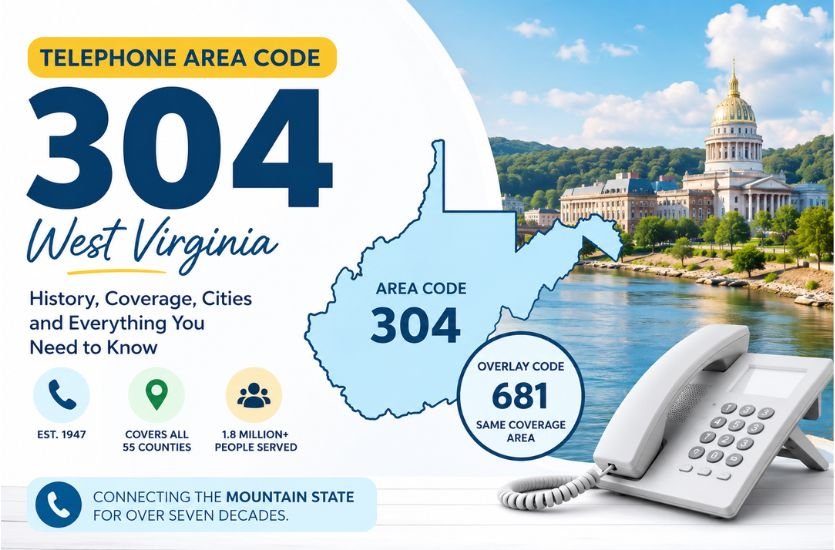

A simple three-digit number can tell an incredible story about a place, its people, and its history. Telephone area code 304 is far more than a routing code used to connect phone calls—it has become a recognizable symbol of West Virginia. For decades, this iconic area code has connected families, businesses, government offices, schools, and communities across the Mountain State. Whether someone is calling from the bustling streets of Charleston, the university town of Morgantown, or the scenic mountains of the eastern panhandle, area code 304 has long represented the entire state.
Today, despite the addition of an overlay area code, 304 continues to hold a special place in the identity of West Virginia. It appears on business signs, apparel, local brands, and social media, serving as a reminder of the state’s rich history and strong sense of community. Understanding how area code 304 came into existence, where it is used, and why it remains important offers fascinating insight into both telecommunications and West Virginia itself.
Also Read: Обикновена Елда: A Complete Guide to Nutrition, Health Benefits, Uses, and Cultivation
What Is Telephone Area Code 304?
Telephone area code 304 is a geographic telephone area code in the North American Numbering Plan (NANP) that serves the entire U.S. state of West Virginia. Introduced in 1947, it was one of the original area codes established when the North American telephone system was first organized into standardized numbering regions.
Unlike many states that are divided among several area codes, West Virginia was assigned only one because of its relatively small population and lower demand for telephone numbers during the early years of the telephone network. For more than sixty years, every landline and mobile phone in the state used area code 304.
As technology advanced and the number of mobile phones, internet connections, and business communication systems increased dramatically, the available pool of telephone numbers gradually became exhausted. To address this growing demand, area code 681 was introduced as an overlay. Today, both area codes serve the same geographic region while preserving the familiar identity of the original 304.
The History Behind Area Code 304
The story of area code 304 begins with the creation of the North American Numbering Plan in 1947. At that time, the Bell System developed a nationwide telephone numbering system that assigned unique three-digit area codes to different geographic regions across the United States, Canada, and several neighboring countries.
West Virginia received area code 304 during this initial rollout. Because the state’s population was modest and widely distributed across rural communities and small cities, a single area code was more than sufficient for decades.
Throughout the second half of the twentieth century, the state experienced steady growth in telephone usage. Landline telephones became common in homes, businesses expanded their communication systems, and government agencies relied increasingly on telephone networks. Even with these developments, the supply of available numbers remained adequate for many years.
The arrival of mobile phones in the 1990s significantly changed the landscape. Every cell phone required its own unique telephone number. At the same time, fax machines, pagers, internet dial-up services, broadband providers, and Voice over Internet Protocol (VoIP) services all contributed to the increasing demand for numbering resources.
After careful planning by telecommunications regulators, area code 681 officially entered service in 2009 as an overlay to area code 304. Instead of dividing West Virginia into separate geographic regions, both area codes now coexist across the entire state.
Where Is Area Code 304 Located?
Area code 304 serves every corner of West Virginia. From the Ohio River in the west to the Appalachian Mountains in the east, the area code reaches all 55 counties of the state.
This statewide coverage makes 304 unique among American area codes. Many larger states require multiple area codes because of population density, while West Virginia has historically maintained a unified telephone identity.
Whether someone lives in a major city, a suburban neighborhood, or a remote mountain community, they may have a telephone number beginning with area code 304 or its overlay, 681.
Major Cities Served by Area Code 304
Area code 304 covers all of West Virginia’s largest and most recognizable cities. Charleston, the state capital, is one of the most prominent locations using the area code. As the political, economic, and cultural center of the state, Charleston has long been associated with 304 telephone numbers.
Huntington, located along the Ohio River, is another major city served by the area code. Known for its educational institutions, healthcare facilities, and manufacturing industries, Huntington has played an important role in the state’s development.
Morgantown, home to West Virginia University, also falls within the 304 service area. The city’s large student population and expanding technology sector contribute to the ongoing demand for new telephone numbers.
Other notable cities include Parkersburg, Wheeling, Beckley, Martinsburg, Clarksburg, Fairmont, Bluefield, Weirton, Princeton, South Charleston, Bridgeport, and Charles Town. Together, these communities represent the diverse economic and geographic landscape of West Virginia.
Counties Covered
Unlike states divided into several telephone regions, every county in West Virginia falls under the coverage of area code 304 and overlay area code 681.
This includes Kanawha County, Cabell County, Monongalia County, Berkeley County, Raleigh County, Wood County, Harrison County, Ohio County, Mercer County, Jefferson County, and dozens of other counties spread throughout the Appalachian region.
The statewide coverage simplifies telephone routing and reinforces the shared identity associated with the 304 designation.
Why Area Code 681 Was Added
By the early 2000s, telecommunications experts recognized that the available telephone numbers within area code 304 were gradually running out.
The explosion of wireless devices dramatically accelerated number usage. Many households now owned multiple mobile phones, while businesses required additional direct lines, customer service numbers, and internet communication systems.
Rather than splitting West Virginia into separate geographic numbering regions, regulators chose an overlay approach. This meant introducing area code 681 while allowing existing customers to keep their familiar 304 numbers.
Today, new telephone subscribers may receive either a 304 or 681 number depending on availability. Both area codes function identically and cover exactly the same territory.
Mandatory Ten-Digit Dialing
One significant change resulting from the overlay system is mandatory ten-digit dialing.
Before the introduction of area code 681, many local calls within West Virginia could be completed by dialing only seven digits. After the overlay became active, callers were required to dial the complete ten-digit telephone number, including the area code, even when making local calls.
Although this adjustment required some adaptation, it has become standard practice throughout the state and ensures accurate call routing between numbers assigned to either area code.
Time Zone and Calling Hours
Area code 304 operates entirely within the Eastern Time Zone.
Residents observe Eastern Standard Time during the colder months and Eastern Daylight Time during daylight saving time. Businesses, schools, healthcare providers, government agencies, and emergency services all operate according to this time zone.
For people outside West Virginia, understanding the time difference can help avoid placing calls too early in the morning or late in the evening.
Population Served
Area code 304, together with overlay area code 681, serves approximately 1.8 million residents throughout West Virginia.
Although the state’s population is smaller than many others in the United States, the demand for telephone numbers continues to grow because individuals often own multiple communication devices. Businesses also maintain numerous telephone lines for customer support, sales, administration, and remote work operations.
This continued growth demonstrates why the addition of area code 681 became necessary despite West Virginia’s relatively stable population.
Business Importance of Area Code 304
For businesses operating within West Virginia, having a 304 telephone number carries significant value.
Local customers often recognize the area code immediately, associating it with companies that have an established presence in the state. This familiarity can increase trust and encourage customers to answer incoming calls from local businesses.
Many startups, professional services, law firms, healthcare providers, contractors, and retailers actively seek 304 numbers because they reinforce a strong regional identity.
Marketing campaigns frequently incorporate “304” into company branding, slogans, promotional materials, and even product names. This practice reflects the area’s cultural significance rather than simply serving as a telephone identifier.
Cultural Significance
Over the years, area code 304 has evolved beyond its technical purpose.
For many West Virginians, the number symbolizes home, community, and state pride. Clothing brands, local organizations, sports fans, musicians, and artists regularly feature “304” in logos, apparel, and social media usernames.
Residents who move to other states often continue to identify with the area code, viewing it as a reminder of their roots and heritage.
This emotional connection makes area code 304 one of the most recognizable regional telephone codes in the United States.
Common Uses of Area Code 304 Numbers
Area code 304 is used by a wide range of organizations and individuals throughout West Virginia.
Government agencies rely on it for administrative communication and public services. Educational institutions use 304 numbers for admissions offices, faculty departments, and student services. Hospitals, medical clinics, emergency responders, and healthcare providers also operate extensively within the area code.
Private residents continue to use 304 numbers for home telephones and mobile devices, while businesses across every industry maintain local customer service and sales lines using the familiar code.
Scam Calls and Caller ID Spoofing
Like virtually every telephone area code in North America, area code 304 is sometimes associated with unwanted spam calls or fraudulent schemes.
However, the appearance of a 304 number does not necessarily indicate that the caller is physically located in West Virginia. Modern caller ID spoofing technology allows scammers to display almost any telephone number they choose.
Consumers should remain cautious when receiving unexpected calls requesting personal information, financial details, passwords, or payment. Verifying the identity of unknown callers and contacting organizations directly through their official telephone numbers remains the safest approach.
The Future of Area Code 304
Despite ongoing technological changes, area code 304 continues to be one of the most recognizable symbols of West Virginia.
As communication technology evolves, the need for additional numbering resources may continue to grow. Mobile devices, smart home systems, internet-connected equipment, and business communication platforms all contribute to increasing demand for telephone numbers.
Nevertheless, the introduction of area code 681 has provided a long-term solution, ensuring that existing 304 numbers remain in service while allowing sufficient capacity for future growth.
Because of its historical significance and cultural importance, area code 304 is expected to remain a defining feature of West Virginia for generations to come.
Frequently Asked Questions
Many people wonder whether area code 304 covers only certain parts of West Virginia. The answer is no. It serves the entire state alongside area code 681.
Another common question is whether older residents are more likely to have 304 numbers. In many cases this is true because existing customers were allowed to keep their original numbers when the overlay was introduced.
People also ask whether businesses can still obtain 304 numbers. Depending on number availability and the telephone provider, businesses may receive either a 304 or 681 number.
Finally, some callers assume every 304 number originates within West Virginia. While most legitimate numbers do, caller ID spoofing means that displayed numbers cannot always be trusted without additional verification.
Conclusion
Telephone area code 304 represents far more than a simple telephone prefix. As one of the original area codes established in 1947, it has connected generations of West Virginians through decades of social, economic, and technological change. Covering every county and every major city in the state, it has become an enduring symbol of local identity and pride.
Although area code 681 now shares the same geographic territory, the legacy of 304 remains unmatched. Businesses continue to value it for its local recognition, residents proudly associate it with their home state, and visitors quickly learn that the number carries a unique cultural meaning across the Mountain State. Whether used for personal communication, business operations, or regional branding, telephone area code 304 continues to represent the history, resilience, and close-knit communities that define West Virginia.